The Smart-Home Display Has a Handover Problem Before It Has a Hardware Problem
Apple’s HomeView puts a shared screen at the centre of a connected home. The durable opportunity sits in the work around it: helping a household map compatible devices, shared access, and account recovery before confusion becomes a support call.

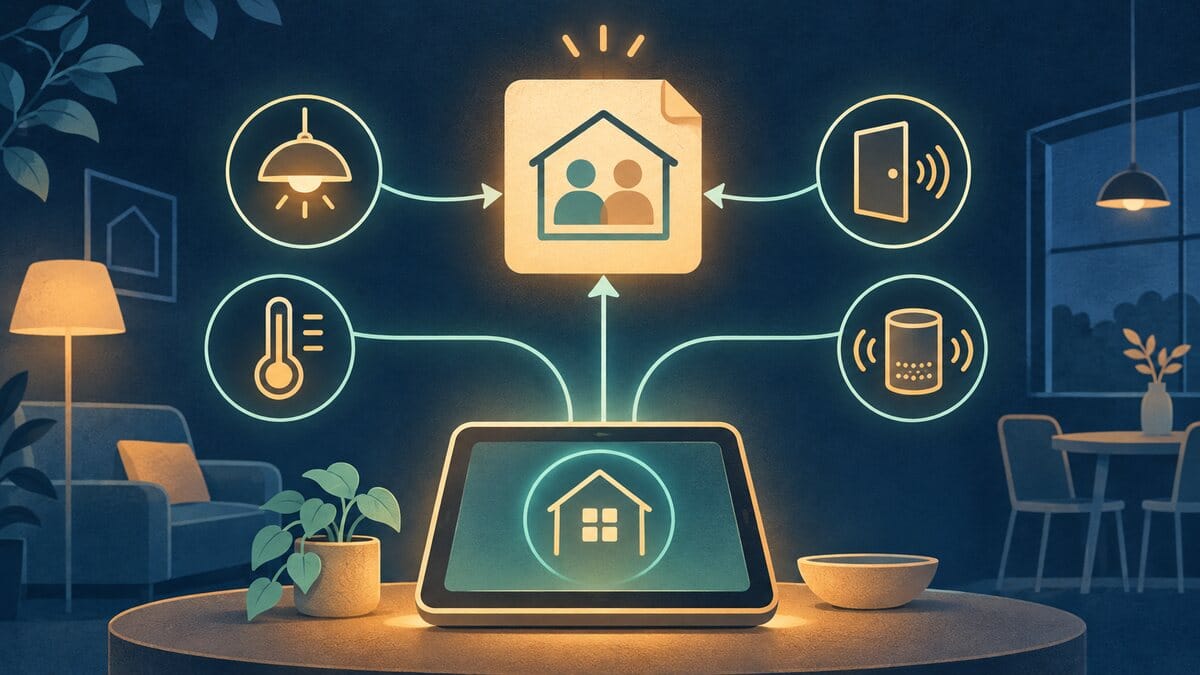
A shared screen exposes the household decisions hiding behind every connected device
Apple’s HomeView is a smart-home display intended to bring controls, household information, and compatible accessories into one visible place. Its commercial appeal is easy to understand. A wall or countertop screen can make lights, climate controls, cameras, speakers, and routines feel less like a collection of phone apps and more like a shared household utility.
The harder question starts after the screen is unpacked. Which accessories work with the household’s chosen platform? Which person owns each account? Who can change a lock, view a camera, or invite another user? What happens when the person who set everything up changes phones, moves away, or cannot remember which account controls a device?
Those questions create a small, credible service opportunity. The useful offer is a household handover: a limited visit or remote session that turns a scattered set of devices and accounts into a clear record. It does not require stocking displays, keeping customer passwords, or presenting oneself as an electrician or security professional.
For a reader weighing a few hundred euros and several weekends, that distinction matters. Hardware resale ties up cash and leaves a newcomer competing with large retailers. A tightly scoped handover service sells clarity around a purchase the household has already chosen to make.
The display belongs to a longer shift from single-user gadgets to shared home systems
Early connected-home products often solved one task at a time. A speaker handled music and voice commands. A bulb changed colour. A camera sent a notification. Each device could be useful on its own, while the household still had to remember several apps, accounts, permissions, and setup steps.
Standards work has pushed the market toward interoperability. The Connectivity Standards Alliance describes Matter as a common application layer for smart-home products, designed to let compatible devices work across ecosystems. Its multi-admin capability allows a device to connect with more than one ecosystem, subject to the user’s choices. Apple’s Home app likewise describes controls for compatible accessories and household sharing. A display such as HomeView makes that shared-control model more visible.
Visibility helps, yet it also reveals weak foundations. A family may discover that the phone used for setup belongs to one former resident. A renter may have an accessory that remains tied to a landlord’s account. A camera can be technically connected while household members have different expectations about viewing access. An older relative may be able to press a screen button while having no route to recover access after a phone replacement.
The product category therefore has two layers. The first is hardware and software. The second is household governance: ownership, permissions, routines, exceptions, and recovery. The second layer is where a careful small operator can add value.
A four-part handover record turns setup into something a household can keep using
A useful service should leave behind evidence, not a vague claim that everything has been configured. The simplest version is a plain-language household handover record with four parts.
Connected-device list. Record the device category, room, platform, power method, and the household purpose. A reader can then see whether a display is controlling lights, climate, entertainment, or access-sensitive equipment. The record should identify devices that need a firmware update, a bridge, a compatible hub, or a different standard before promising integration.
Ownership map. Record the account owner for each relevant ecosystem and accessory, plus where recovery details are held. The service provider should never take custody of passwords, recovery codes, or identity documents. The owner makes account changes while the provider explains the steps.
Permission map. List who can use routine controls, who can administer the household, and which controls require an explicit household decision. Cameras, locks, alarms, garage doors, and location-linked routines deserve a separate conversation because convenience and privacy meet in the same setting.
Recovery path. Write down what the household should do after a phone change, router replacement, unexpected logout, or departing household member. The useful outcome is a known first step and a list of official support routes, rather than an assurance that every failure can be repaired during one visit.
This record is the MarketLens contribution to the purchase decision. Compatibility tells a buyer that products may connect. A handover record tells a household who can operate the system and how it remains understandable when circumstances change.
Where the money flows, and where a small entrant fits
Large companies make money from the category at several layers. Apple sells hardware and earns broader revenue from products and services across its ecosystem. Its annual reports make clear that the company’s scale rests on global device sales, services, retail, software, and an extensive supply chain. That structure funds product development, operating systems, support, distribution, and platform integration that a local provider cannot replicate.
Amazon illustrates another route. Its consumer-device and smart-home ecosystem connects devices, retail, cloud infrastructure, and subscriptions. The company reports sales across broad business segments rather than a standalone smart-home display line, so those figures should not be read as revenue from any one device. The important lesson is structural: established firms benefit from hardware distribution, recurring services, customer accounts, and a large installed base.
Accessory makers take a third route. They sell lights, plugs, sensors, cameras, locks, hubs, and related devices through retail and distribution partners. Installers may earn from labour, call-outs, maintenance, and higher-complexity system work. Platforms may gain from services or subscriptions attached to storage, monitoring, entertainment, or cloud features.
An ordinary entrant has a narrower, more realistic layer. The customer pays a fixed fee for a compatibility review, a household inventory, a shared-access conversation, and a recovery record. The provider receives that service fee. The service becomes more valuable through care, clear boundaries, and referrals rather than through ownership of the hardware margin.
That position has a modest moat. A generic setup checklist is easy to copy. Local trust, a careful privacy boundary, and an understandable record tailored to a real home are harder to replace with a retailer’s quick-start leaflet. The moat remains limited, so the offer needs a tight radius, a repeatable format, and referrals from adjacent professionals such as home organisers or non-electrical technology tutors.
The service works best when the scope stays narrow
The first offer can be called a “Smart-Home Handover Visit.” It should state its finish line clearly: a household receives an inventory, an ownership and permission map, a list of compatibility questions, and a recovery page. The customer operates every sensitive account during the session.
Suitable households have a few compatible accessories, a shared-home need, and uncertainty about who controls what. They may be moving home, combining households, replacing an old hub, or helping a relative understand a system already in place.
Electrical changes, fixed wiring, alarm monitoring, emergency-response systems, structural mounting, and fault diagnosis sit outside that boundary. Those jobs may require licensed or qualified local professionals, and rules vary by country. A provider should refer the work rather than stretching a documentation visit into a safety-critical installation.
The same restraint applies to cameras and locks. A service can explain official settings and help the household document its own decisions. It should avoid keeping access, representing itself as a security company, or deciding who deserves permission. Trust is the product, and a clear boundary protects it.
Test demand before buying stock or building a website
The smallest sensible test is five conversations with households that already own connected accessories or plan to buy a display. Ask what they are trying to control, whether more than one person uses the system, and which setup or recovery task they avoid. Offer a fixed-scope paid pilot to the households whose needs fit the boundary.
Use a simple one-page deliverable. The page can include the four handover sections, official support links, and an “owner action” column for any account work. Price the pilot as a service fee that covers preparation, the session, and the record, with no device markup and no promise of electrical or security work.
Two paid bookings, a repeat request after a move or phone change, or a referral from the first five conversations is a useful demand signal. A pattern of requests for free buying advice or complex installation work is equally useful evidence. It shows that the offer needs a different customer, a referral partner, or a clean stop.
Avoid buying inventory in advance, paid advertising, password storage, and broad claims that every device will work together. Compatibility changes with product versions, regional availability, and software updates. The customer should see the official documentation and make the final purchase decision.
Household confidence is the product a small operator can sell
HomeView brings attention to a familiar smart-home promise: one place where a household can see and control its connected environment. The lasting business lesson concerns the unresolved work around shared ownership, permissions, and recovery.
A small operator can participate by making that work visible and bounded. Start with a paid handover record for homes that already have the hardware. Keep sensitive credentials in the owner’s hands. Refer electrical and monitored-security work to qualified providers. That approach limits capital exposure while testing whether clarity earns a fee.
Sources
- Apple Home app and compatible accessories
- Apple Home user guide: share control of a home
- Connectivity Standards Alliance: Matter
- Connectivity Standards Alliance: multi-admin
- Apple annual reports
- Amazon annual reports and SEC filings