Diesel Fuel Surcharges: The Small Business Opportunity Is in Clearer Freight Bills
Diesel price swings do not create a simple fuel-selling opportunity for small operators. They create a costly reconciliation problem between carriers and shippers, where transparent surcharge rules can be worth paying for.

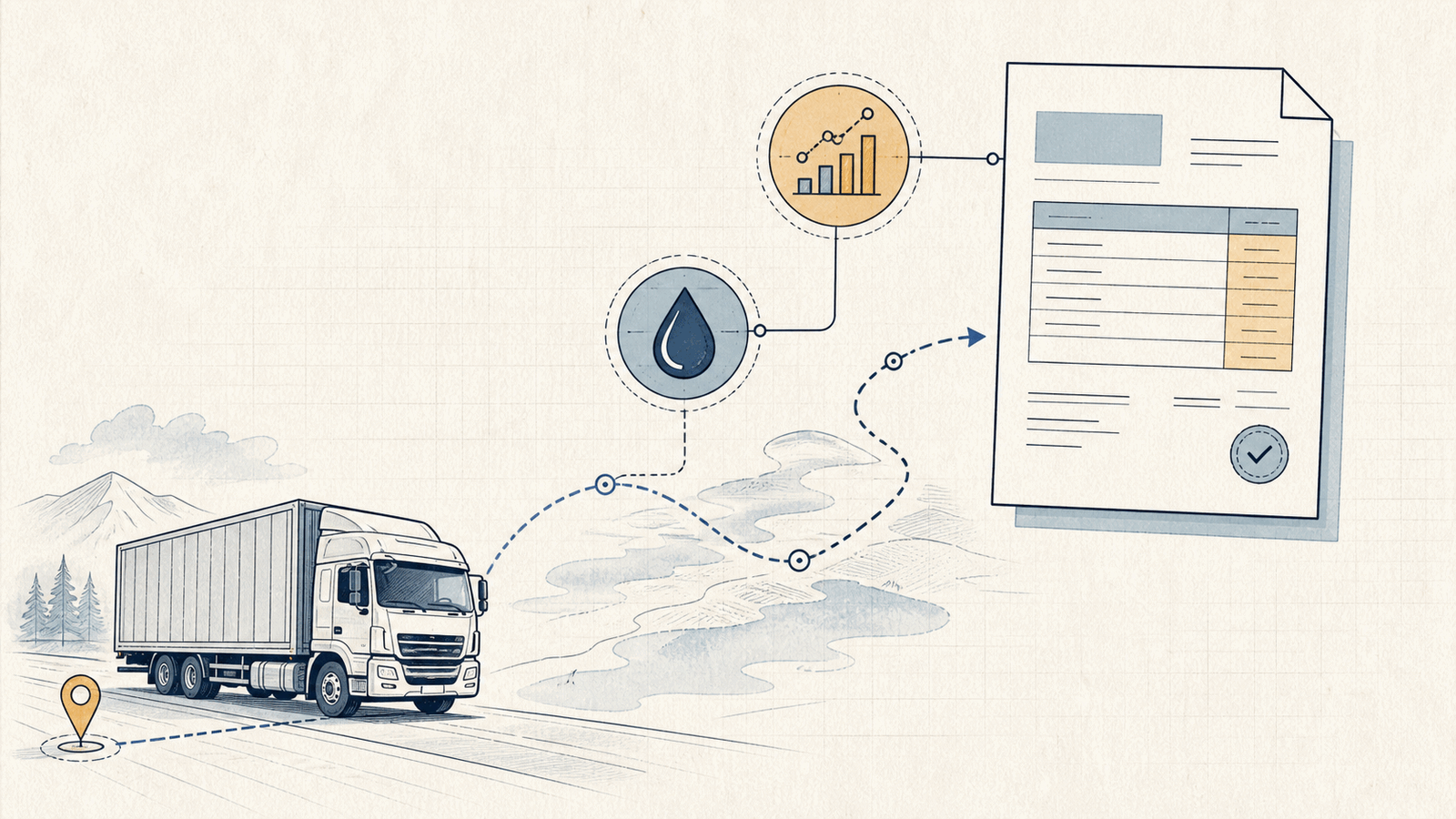
Diesel fuel matters to freight businesses long before a truck reaches a filling station. A change in fuel cost can alter a carrier's margin, a shipper's invoice, and the price comparison a customer uses to choose a transport provider. For a small operator, that does not make diesel resale an easy business. It creates a narrower and more realistic opening: help a carrier or shipper make fuel surcharges understandable, consistent, and easy to check.
The useful product is not a prediction about fuel prices. It is a reliable link between an agreed index, a contract rule, a shipment, and an invoice. That distinction matters because a surcharge can protect a carrier from a cost change while still becoming a source of disputes when customers cannot see how it was calculated.
Diesel cost reshapes the freight bill
Diesel's retail price is made up of more than crude oil. The U.S. Energy Information Administration explains that refining, distribution, marketing, retail operations, taxes, and local conditions all affect what a buyer pays. The exact tax and product rules differ by country, but the underlying business lesson travels: a carrier's fuel cost can move for reasons outside its control.
That is why freight companies often separate base transport from a fuel-related adjustment. The World Bank's trucking performance framework notes that diesel can represent 20% to 40% of operating costs for asset-based trucking companies, depending on the market. It also warns that comparing freight prices without separating fuel surcharges can obscure whether the underlying transport service has become more or less competitive.
The point is not that every carrier should charge the same surcharge. It is that a rate sheet needs a stated reference price, update frequency, base amount, scope, and rounding rule. Without those pieces, a shipper sees a changing extra line. A carrier sees cost recovery. Both may be looking at the same invoice and talking past each other.
The evidence points to a documentation gap
Large logistics companies make their methods visible because customers need a way to verify them. FedEx publishes that its relevant ground-service fuel adjustment is based on a weekly published diesel price, while its agreement remains the final authority on the calculation. DHL shows the same general pattern in several markets. Its Portugal ecommerce policy uses a European diesel price index and applies a prior-month average to the following month's charge. Its Slovak freight guidance describes a monthly adjustment based on a multi-week EU diesel average.
Those examples do not prove that a small carrier can charge the same rates or copy a multinational's system. They reveal the customer requirement behind the charge: the rule has to be explainable. A large provider can maintain rate tables, contract teams, billing systems, and customer support. A one-vehicle carrier, a small forwarder, or a local distributor may instead rely on spreadsheets, old email threads, or a generic percentage that has drifted away from its contract.
That is the potential service gap. The buyer is not paying for a fuel forecast. They are paying for fewer avoidable invoice questions, a repeatable calculation, and a record that can be shown to a customer or accountant.
Where a small entrant can participate
The most credible offer is a bounded fuel-surcharge audit and setup service for a specific transport niche. It might serve local courier firms, small hauliers, independent freight brokers, or distributors that arrange recurring deliveries. The work could include:
- mapping the client's existing rate sheets and invoices;
- identifying the index, base price, update date, and percentage rule already promised in each customer agreement;
- building a plain-language surcharge schedule and invoice note;
- checking a small sample of past invoices against that schedule; and
- creating a monthly checklist for the person who updates prices.
The customer pays for administrative certainty and clearer commercial communication. The carrier or broker keeps the revenue that should have been recovered under a valid agreement, or avoids charging a figure it cannot support. The service provider earns a fixed project fee or a modest recurring fee for maintaining the schedule. It should not take a percentage of recovered money without checking local rules, contract terms, and the risk of becoming involved in a dispute.
This is different from becoming a fuel reseller, financing fuel purchases, or promising savings. Those paths need capital, supplier relationships, credit controls, compliance knowledge, and operational capacity. A billing-audit service is still detail-heavy, but it can begin with document handling and arithmetic rather than inventory.
A transparent calculation is the product
A useful setup separates the parts of the bill. Imagine a carrier has agreed that fuel represents 25% of its base transport price. Its reference diesel price at the time of the agreement is 1.20 per litre. If the relevant published index later reads 1.44 per litre, the fuel-cost change is 20%.
The surcharge component in this example is 25% multiplied by 20%, or 5% of the base transport price. On a base charge of 400, that is 20. The inputs and method are deliberately visible:
| Input | Example | Why it needs evidence |
|---|---|---|
| Base transport charge | 400 | Must match the customer agreement |
| Fuel share of base cost | 25% | Must be agreed, not guessed |
| Reference diesel price | 1.20 per litre | Must name the source and date |
| Later index price | 1.44 per litre | Must use the same index and unit |
| Calculated surcharge | 20 | 400 × 25% × ((1.44 ÷ 1.20) − 1) |
This is an illustration, not a universal formula or recommended rate. A contract may use bands, a fixed amount per kilometre, a different fuel share, a lag, a cap, or no surcharge at all. Taxes, currency, fuel grades, and index availability also vary by country. The value of the service lies in applying the rule that the parties actually agreed, then showing the arithmetic clearly.
What makes the service credible, and what breaks it
The service has a real constraint: it cannot repair a weak contract by inventing a charge after the fact. If the agreement does not permit a surcharge, the correct result may be a better rate-review process for future work, not a retroactive invoice. If a carrier buys fuel through a discounted card programme while using a public retail index, the provider must disclose that the index is a contractual reference rather than the carrier's exact purchase cost.
Data quality is the second constraint. The EIA's published methodology shows why an index needs a defined method: it collects outlet prices, applies quality checks, and produces volume-weighted estimates. A small service should not present a casual web search or a single station receipt as if it were a reliable market index. It needs an agreed source, saved source records, and a process for handling a missing or delayed publication.
The third constraint is customer acquisition. Very small operators may not have enough recurring billing, or enough friction, to pay for an outside specialist. Firms with a capable transport-management system may already have the feature. The best prospects are not every business that buys diesel. They are operators with repeat routes, customer-specific price agreements, manual updates, and recurring invoice questions.
The smallest sensible test is a document review, not a software build
Before building a dashboard, buying data, or offering to manage every invoice, test the problem with five discovery calls. Ask small carriers or freight brokers which customer questions slow billing, whether they use a written fuel rule, how they choose an index, and whether anyone has challenged a charge in the past three months. Do not ask whether they like the idea. Ask to see a redacted rate sheet and one redacted invoice.
If two or three prospects agree to a fixed-price review of a small invoice sample, the service has a meaningful demand signal. Deliver a short report that reconciles the agreement, index, and invoice. Then measure whether the client adopts the schedule and whether invoice questions fall. Stop if prospects have no recurring issue, decline to share documents, or already get the same result from their software or accountant.
That test costs time and careful confidentiality practice, not inventory. Use a written scope, limit access to customer data, and avoid giving legal, tax, or regulatory advice. Contract, tax, and transport rules vary by country, so an operator should check local requirements or use a qualified local adviser when those rules affect billing.
The practical judgment
Diesel fuel is not a low-risk product trend for most beginners. The capital-intensive parts of the market reward scale, procurement skill, and compliance capacity. The more accessible edge is administrative: make a fuel-related charge traceable enough that a carrier can defend it and a shipper can check it.
That is a modest service, not a shortcut to easy income. It becomes worth pursuing only when a narrow customer group has recurring freight bills, manual surcharge work, and an actual willingness to pay for clearer records. Start with a small document audit. If the documents do not reveal a repeated problem, do not build a bigger business around diesel.
Sources
- U.S. Energy Information Administration: Diesel prices and outlook
- World Bank: Trucking performance assessment framework
- FedEx: Fuel surcharge information
- DHL eCommerce Portugal: Fuel surcharge
- DHL Freight Slovakia: Surcharges
- U.S. Energy Information Administration: Weekly diesel price methodology