Electricity Tariffs: The Small Business Opportunity in Explaining the Bill
Electricity becomes harder to budget when the price changes by hour, region, and tariff. The useful small-business opening is not predicting power markets. It is showing a customer which parts of a real bill can change and which cannot.

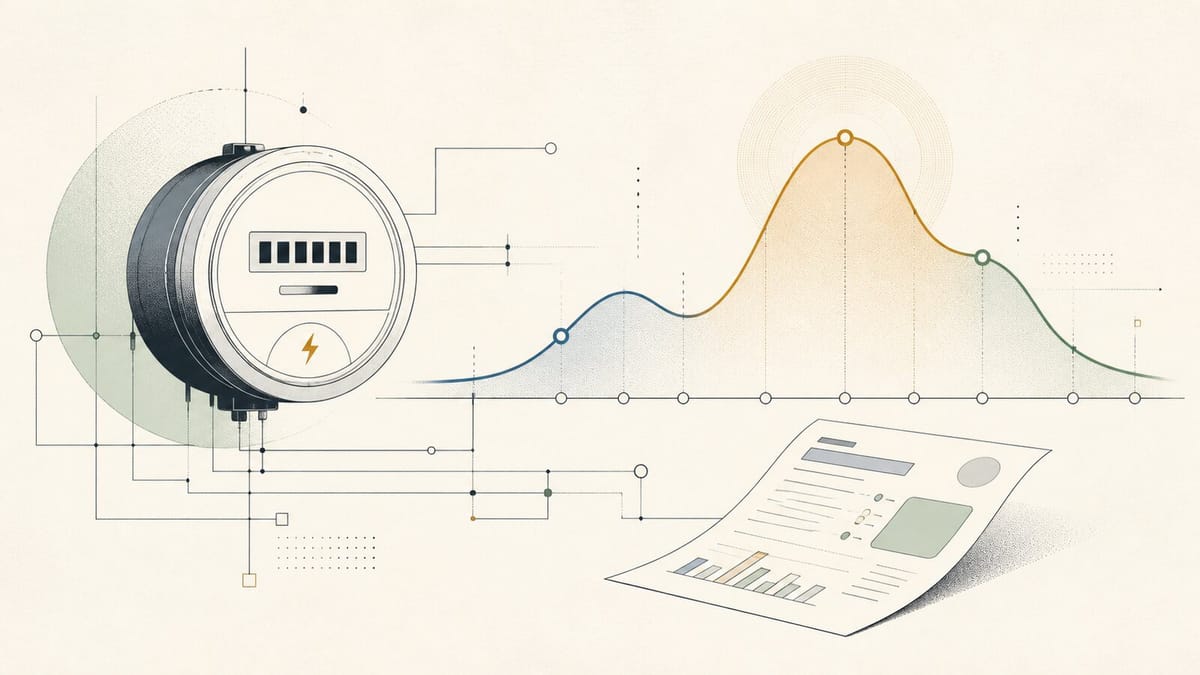
People who search for electricity prices are usually trying to answer a more practical question: why did the bill change, and can I do anything about it? That question is becoming harder where tariffs vary by time, usage band, location, or contract type. Norway is a clear example. Its energy regulator publishes hourly price and support data, while the United Kingdom's regulator distinguishes single-rate electricity from multi-rate tariffs that charge different prices at different times.
That complexity creates a real service opportunity, but a narrow one. A small entrant is unlikely to beat an energy supplier at tariff comparison, data access, or regulatory advice. They can, however, help a local business understand its own bill, identify controllable loads, and decide whether a tariff change is even worth investigating. The value is an accurate interpretation and a sensible next step, not a promise to make electricity cheap.
The bill is a bundle of different decisions
An electricity bill can combine fixed charges, network charges, taxes, a supplier margin, and consumption charged at one or more unit rates. A price alert captures only one of those pieces. Ofgem's unit-rate guidance makes the distinction plainly: a single-rate customer pays the same electricity unit rate throughout the day, while a multi-rate customer can pay different peak and off-peak rates.
The important business implication follows from that distinction. A bakery, small workshop, laundry, café, or home office does not save money merely because it has access to a lower overnight rate. It saves only when enough of its flexible consumption can move into the cheaper period without damaging the service it sells.
That makes the customer problem a mapping problem. The customer needs to connect three facts that are often kept apart: the tariff terms, the times when equipment uses electricity, and the operating constraints that prevent shifting work. A reliable bill-analysis service can bring those facts together in one readable page.
Price variation is real, but it is not a universal saving
Norway's energy regulator explains that electricity supply and consumption must balance hour by hour, and that market prices can vary with demand, available generation, weather, and the cost of the marginal production needed to meet demand. This explains why hourly or dynamic prices can exist. It does not mean every customer should choose them.
The same caution appears in the United Kingdom. Ofgem says an Economy 7 tariff may help customers who use more electricity at night, such as for storage heating or electric-vehicle charging. The condition matters. A customer whose main consumption is fixed during expensive hours may pay more after switching.
Here is a simple screening calculation a service provider can show without pretending to forecast prices. Suppose a customer can move 30% of 1,000 monthly kilowatt-hours from a peak rate of 30 cents to an off-peak rate of 20 cents. The theoretical energy-charge reduction is 300 kWh multiplied by 10 cents, or 30 currency units before any fixed charge, network fee, tax, equipment cost, or operational disruption. If only 5% of usage is genuinely movable, the same price gap produces only five currency units. The method is transparent: movable usage multiplied by the unit-rate difference. The result is a screening estimate, not a saving guarantee.
The calculation creates publisher value because it changes the question from "Which tariff is cheapest?" to "How much of this customer's load can move, at what cost, and who must change their routine?" That is the question a small operator can answer honestly.
Where established energy companies earn their advantage
The large players operate across a far broader value chain. Octopus Energy Group's FY25 annual report says the group supplied 10 million retail and business customers across eight countries and reported GBP 13.683 billion in revenue, with GBP 13.027 billion from gas and electricity sales. Its operations also include energy services, hardware, generation management, and software licensing.
That scale matters. Energy suppliers and their technology partners can price contracts, process meter data, fund customer support, manage regulation, and carry credit and market risk. A new local consultant should not copy that model by reselling electricity, holding customer money, or telling clients which regulated contract they should sign.
The accessible layer sits beside the supplier relationship. A small operator can sell a fixed-fee review of a bill, a usage diary, and a short list of operational questions. The payer is a small business owner or property manager who wants a clearer cost-control decision. The useful outcome is not a tariff recommendation. It is a documented explanation of which line items are fixed, which usage is flexible, and what information the customer needs from a licensed supplier or local adviser.
A useful offer has a tight boundary
The most credible first offer is an "electricity bill and load map" for one type of local customer, such as a laundrette, small restaurant, or workshop. It could include:
- a plain-language explanation of the invoice and contract terms;
- a one-week log of high-load equipment and operating hours;
- a simple calculation of the maximum possible benefit from shifting flexible loads;
- questions for the client's supplier, accountant, or energy adviser; and
- a stop rule explaining when the tariff is too complex, the savings are too small, or regulated advice is required.
This is different from a generic spreadsheet download. The service has value only when it reflects a specific customer's operating hours and constraints. It also has limits. In many countries, tariff comparison, energy brokerage, data access, and advice carry consumer-protection, licensing, privacy, or contract rules. The operator should check local rules and obtain consent before handling bills or meter data. Readers should also check local tariff and regulatory requirements or consult a qualified local adviser where appropriate.
Test demand before building software
The smallest sensible test is five structured conversations with one customer type, followed by two manually prepared bill maps using redacted bills and written permission. Set a clear cap on time and charge a modest fixed fee only if the customer says the output would change a real decision. The demand signal is not a social-media response. It is whether an owner will share the bill, explain their operating schedule, and pay for a clearer analysis.
Use a simple stop rule. Do not build software, buy advertising, or market tariff-switching services unless those first customers reveal the same recurring problem and the analysis changes a decision. If every bill is too different, the data cannot be obtained safely, or the customer only wants a guaranteed lower price, the service does not have a repeatable low-risk case.
The opportunity is interpretation, not prediction
Electricity-price interest points to a durable cost-control problem, but the commercial opening is smaller than it first appears. Large suppliers make money from regulated supply, technology, data, and customer scale. A small entrant can create value by translating a confusing bill into an operational decision, provided the work stays local, consent-based, and clear about its limits.
Pursue this only if you know one customer type well enough to map its equipment, work hours, and constraints. Watch it if you can produce a useful manual review. Avoid it if the plan depends on predicting energy markets, reselling power, or promising savings that the bill and operating schedule cannot support.
Sources
- NVE: Electricity prices and why they vary
- NVE electricity-market statistics
- Ofgem: Energy price-cap unit rates and standing charges
- Ofgem: Economy 7 tariff guidance
- Ofgem: Flexibility and Net Zero survey findings
- Octopus Energy Group FY25 annual report