Agentic Orchestration: The Business Opportunity Behind AI Workflows
Agentic orchestration turns AI from a helpful answer box into a coordinated workflow system. The opportunity is promising, but it belongs to builders who can package trust, integration, and oversight.

Why People Are Searching for Agentic Orchestration
Agentic orchestration is rising because companies are learning a hard lesson about AI: a useful answer is not the same as a finished job.
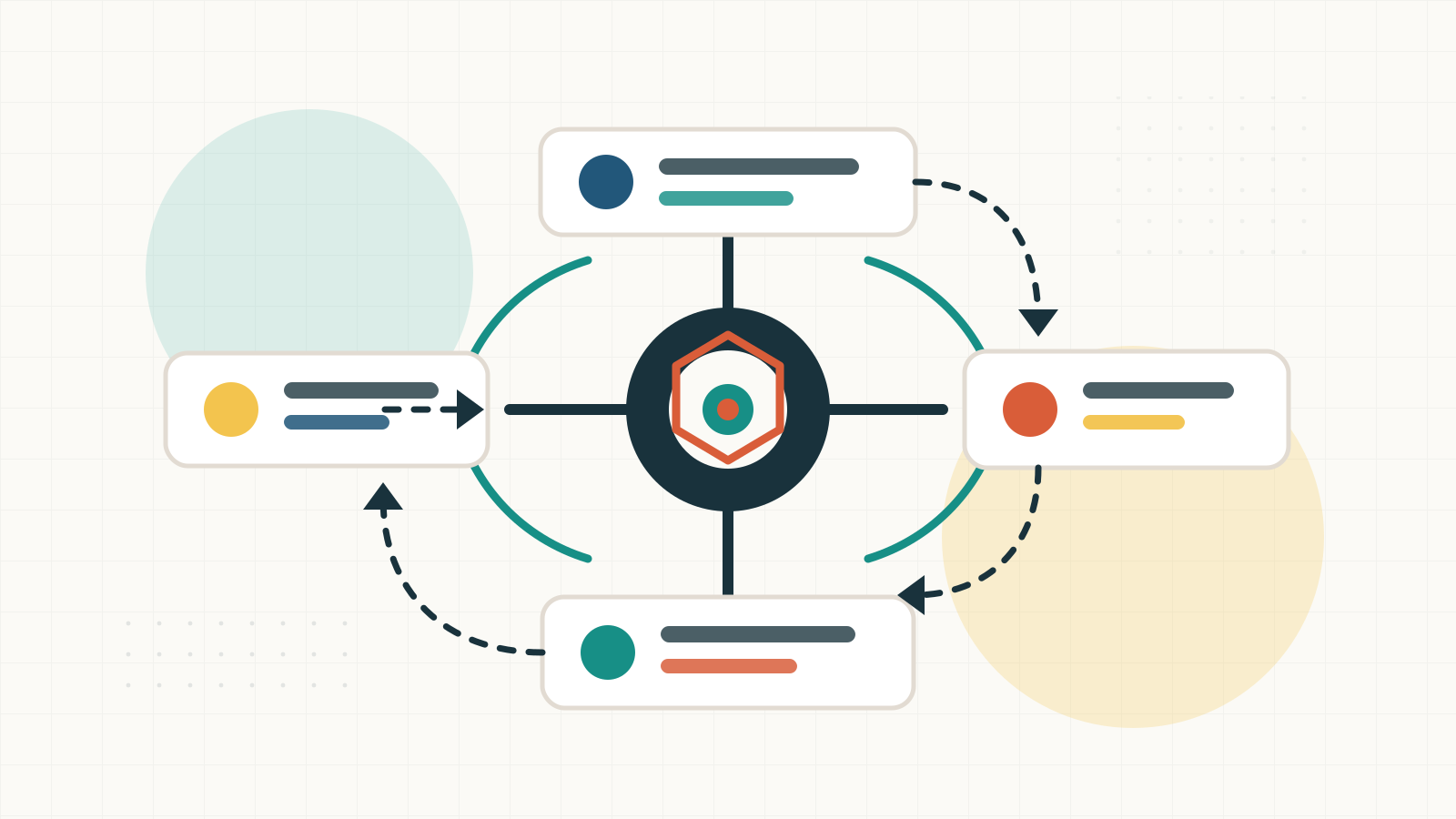
A chatbot can summarize a policy, draft an email, or explain a document. An agentic workflow tries to go further. It can decide which step comes next, call tools, pass work to a specialized agent, ask for approval, update a record, and keep the process moving across systems. Agentic orchestration is the layer that coordinates those agents so the work does not become a pile of disconnected automations.
Exploding Topics lists agentic orchestration among its fast-growing search topics, which fits the broader business mood. Companies have spent heavily on generative AI pilots. Many now want operational results: faster support queues, cleaner back-office processes, shorter sales handoffs, more reliable onboarding, and fewer manual status checks.
IBM describes AI agent orchestration as coordinating multiple specialized AI agents inside a unified system so they can work toward shared objectives. Its watsonx documentation explains the practical pattern: a primary agent delegates work to collaborator agents, gathers their outputs, and produces a final result. That is the commercial reason people search for the term. They are not only asking what it means. They are asking how to turn AI into repeatable work.
For entrepreneurs, consultants, software builders, and publishers, the opportunity is useful but not effortless. Agentic orchestration creates demand for design, integration, governance, training, monitoring, templates, and niche implementation. It also creates risk. The more an AI system can do, the more important it becomes to control what it is allowed to do.
The Short History Behind Agentic Orchestration
The idea has roots in older automation. Businesses have long used workflow tools to move tasks from one system to another: create a ticket, send an alert, update a spreadsheet, route an approval, or trigger an invoice. Traditional workflow orchestration coordinates those automated tasks across business applications. IBM defines workflow orchestration as coordinating automated tasks so they follow a logical sequence and connect with other systems.
Generative AI changed the shape of that market. Instead of only following fixed rules, AI systems can interpret messy instructions, draft responses, classify requests, summarize context, and decide which tool might help. Agentic AI adds more autonomy: the system can pursue a goal with limited supervision, using tools, APIs, databases, and other agents.
That shift explains why orchestration matters. A single general-purpose assistant is often too broad for business operations. A finance task may need one agent for invoice classification, another for policy checks, another for vendor lookup, and another for exception handling. A customer-service task may need agents for billing, order status, knowledge-base search, refund policy, and escalation.
Orchestration tries to make those pieces work together. It defines roles, handoffs, context sharing, sequencing, approvals, and failure paths. In plain language, it is the difference between having several capable assistants and having a managed operating process.
The category is moving from technical curiosity toward enterprise packaging. ServiceNow has announced AI Agent Orchestrator and AI Agent Studio as part of its enterprise workflow platform, describing AI agents that can work across enterprise data and workflows. UiPath describes itself as a leader in agentic automation and says its platform combines deterministic automation, agentic AI, and enterprise-grade orchestration. Microsoft’s Power Platform, Copilot ecosystem, and automation products point in the same direction: AI that is embedded in work, not just displayed in a chat window.
The Business Opportunity
The business case for agentic orchestration starts with a visible customer problem: many companies have fragmented work. A customer request arrives in one system. The policy lives somewhere else. The approval path sits in email. The record update happens in a CRM. The report is made manually at the end of the week.
AI can help with pieces of that work, but the value appears when those pieces are connected. That is why agentic orchestration is more monetizable than a generic “AI assistant” offer. It speaks to a specific buyer pain: work is still stuck between tools, teams, and approvals.
The strongest opportunities are likely to sit in narrow workflows where the output can be checked. Good examples include customer support triage, sales research, lead qualification, onboarding checklists, invoice exception routing, internal knowledge retrieval, content operations, compliance evidence gathering, recruiting coordination, and service-ticket follow-up.
The hidden economics are straightforward. A business pays when orchestration saves time, reduces errors, shortens response cycles, improves visibility, or prevents missed steps. The case is weaker when the workflow is rare, poorly understood, legally sensitive, or too dependent on human judgment to automate safely.
For a small operator, the opportunity is not to build a universal enterprise platform. That market already has well-capitalized players. The realistic opportunity is to package expertise around a specific workflow, industry, or tool stack. A consultant might help professional-services firms orchestrate proposal intake. A technical freelancer might build agent workflows for support teams using existing automation platforms. A publisher might create educational content comparing orchestration tools, governance patterns, and use cases.
The demand signal is real, but it is not proof of easy revenue. Customers will ask hard questions: What systems does it connect to? Who approves risky actions? What happens when the agent is wrong? Can we audit the steps? How are credentials handled? Can a human take over? Those questions are not obstacles to the business. They are the business.
Who Is Already Making Money From Agentic Orchestration
Several public companies already monetize the broader demand behind agentic orchestration, even if their revenue lines are reported at a platform or segment level rather than for this exact phrase.
ServiceNow sells enterprise workflow software through subscriptions. It reported quarterly subscription revenue of $3.466 billion for the quarter ended December 31, 2025, up 21% year over year. Its agentic AI announcements matter because the company already sits inside enterprise workflows; AI orchestration becomes a way to deepen the value of that platform.
UiPath makes money from automation software, SaaS, maintenance, support, and services. For its fiscal year ended January 31, 2026, it reported revenue of $1.611 billion and annual recurring revenue of $1.853 billion. UiPath’s positioning is directly relevant because robotic process automation is evolving toward agentic automation: deterministic workflows for reliability, AI agents for judgment-like tasks, and orchestration to coordinate the process.
Microsoft monetizes the theme through cloud infrastructure, Microsoft 365, Copilot, Dynamics, Power Platform, and developer tools. Its annual report shows revenue of $281.724 billion for fiscal 2025, with server products and cloud services and Microsoft 365 Commercial products and cloud services among its largest reported product categories. Microsoft does not need to sell “agentic orchestration” as a standalone niche for the opportunity to matter. It can fold AI workflows into the tools companies already use.
IBM monetizes orchestration through enterprise software, consulting, automation, and watsonx-related offerings. Its public documentation shows how orchestration is packaged: build specialized agents, define collaborator roles, connect applications, and manage delegation.
The lesson for smaller businesses is clear. Large companies make money from platforms, cloud usage, seats, and enterprise contracts. Smaller operators are more likely to make money from implementation, education, templates, audits, integration support, governance design, and niche content.
Ways to Make Money With Agentic Orchestration
A service business can sell workflow audits. The offer is simple: map one process, identify handoffs, decide where agents can help, define human approvals, and produce a small implementation plan. This works best for teams already using tools such as CRMs, support desks, document systems, spreadsheets, project-management software, or automation platforms.
A technical consultant can build small agentic workflows. The first version might not need a custom platform. It may use existing tools, APIs, automations, and model providers. The value is in choosing the right boundary: what the agent can do alone, what it must ask permission to do, and what should stay human.
A creator can build educational content. Searchers need plain-English explanations of agentic orchestration, comparisons between agent platforms, examples of agent workflows, governance checklists, security mistakes, and implementation guides. That can support ads, affiliate relationships where appropriate, sponsorships, lead generation, or paid templates.
A software builder can create vertical templates. A template for recruiting coordination, customer onboarding, invoice follow-up, bug triage, local-service quote intake, or ecommerce returns may be more useful than a generic agent builder. Buyers often pay for a solved workflow, not an empty canvas.
An agency can add orchestration to existing retainers. Marketing agencies, operations consultants, CRM implementers, and IT service providers can package agentic workflows as an upgrade: fewer manual handoffs, faster reporting, better intake, or cleaner follow-up.
A training business can teach safe implementation. Many companies are curious but cautious. Workshops on agent permissions, workflow design, prompt evaluation, human-in-the-loop review, and audit logs can be valuable because the risk is real.
Example Offers You Could Create
- A “one-workflow agentic readiness audit” for support, sales, finance, or operations teams.
- A “customer support triage agent” setup that classifies tickets, drafts replies, finds policy context, and routes exceptions to humans.
- A “sales research workflow” that gathers account context, summarizes public information, drafts outreach notes, and updates the CRM after approval.
- A “content operations agent stack” that turns briefs into outlines, checks sources, prepares publishing tasks, and flags missing approvals.
- A “governed AI workflow checklist” for small teams adopting agents for the first time.
- A niche newsletter covering agentic workflow tools, implementation patterns, pricing, failures, and case studies.
How to Start Small
Start with one painful workflow, not with the technology. Ask where work gets delayed, copied between systems, rechecked, forgotten, or routed manually. The best first project is repetitive enough to matter but contained enough to supervise.
Map the current process in plain steps. Who starts it? What information is needed? Which tools are used? What decisions are made? What can go wrong? Who approves the final action? This map is more important than a demo.
Choose a narrow first outcome. For example: reduce support-ticket triage time, prepare sales-call briefs, summarize customer onboarding status, or collect missing invoice information. Avoid giving the agent broad authority at the start.
Build a prototype with human approval. Let the workflow draft, classify, summarize, or recommend before it acts. Track errors, time saved, user frustration, and the number of cases that still require a person.
Measure cost per useful outcome. Agentic workflows can consume more tokens, integrations, and maintenance than simple chat. A workflow that looks impressive but costs too much to run is not a business case.
Turn the learning into an offer. If the prototype saves time and users trust it, package the implementation, documentation, training, and monthly maintenance. If it does not, narrow the workflow or choose a more measurable one.
Risks and What to Watch Out For
The first risk is over-automation. Some sellers will promise autonomous workflows before the process is ready. That can create bad customer experiences, wrong records, compliance exposure, or expensive cleanup.
The second risk is weak permissions. Agentic systems need access to tools and data. Treat agents like accountable digital workers: define what they can access, what expires, who owns them, and when a human must approve action.
The third risk is unclear measurement. A workflow should have a practical scorecard: time saved, error rate, completion rate, escalation rate, cost per task, and user satisfaction. Without measurement, orchestration becomes theater.
The fourth risk is platform dependence. Tools will change quickly. Pricing, model quality, integrations, and policies can shift. A service business should avoid building its entire value on one vendor’s feature.
The fifth risk is regulated or high-stakes work. Finance, legal, health, employment, insurance, education, and government processes may require extra controls. Agentic orchestration content should stay educational and avoid personalized legal, tax, investment, or professional advice. Readers should check local rules and qualified advisers where relevant.
Who This Is Best For
This opportunity is best for people who understand operations. CRM consultants, automation builders, support-operations managers, RevOps specialists, IT service providers, software consultants, technical writers, and workflow-minded creators have an advantage.
It is also a good fit for people who can explain risk without scaring the buyer. Companies want the productivity upside, but they also need trust, logs, approvals, access control, and rollback plans.
It is less suitable for beginners looking for fast passive income. Agentic orchestration is not a simple content trend or a plug-and-play side hustle. The money is likely to go to people who can translate messy work into reliable systems.
Final Takeaway
Agentic orchestration is worth watching because it names the next practical stage of AI adoption: not just answering questions, but coordinating work. The strongest business opportunities will not come from vague promises of autonomous agents. They will come from narrow, supervised workflows where the customer problem is visible and the result can be measured.
For small businesses and creators, the sensible move is to specialize. Pick a workflow, learn the tools, define the safeguards, prove one useful outcome, and then package the service or content around that evidence. The trend is real, but the durable business is not “AI does everything.” It is “this specific workflow now works better.”
Sources
- Exploding Topics trending topics
- IBM: What is AI agent orchestration?
- IBM watsonx: Orchestrating agents
- IBM: What is workflow orchestration?
- ServiceNow full-year financial results
- ServiceNow agentic AI innovations
- UiPath full-year financial results
- Microsoft annual report