AirTags and the Privacy-First Handover Service
A tracker attached to keys, luggage, or equipment creates a simple technical task and a more delicate human one: who controls the item, who may see it, and what happens when it changes hands. A privacy-first handover service can turn that uncertainty into a clear, owner-led record.

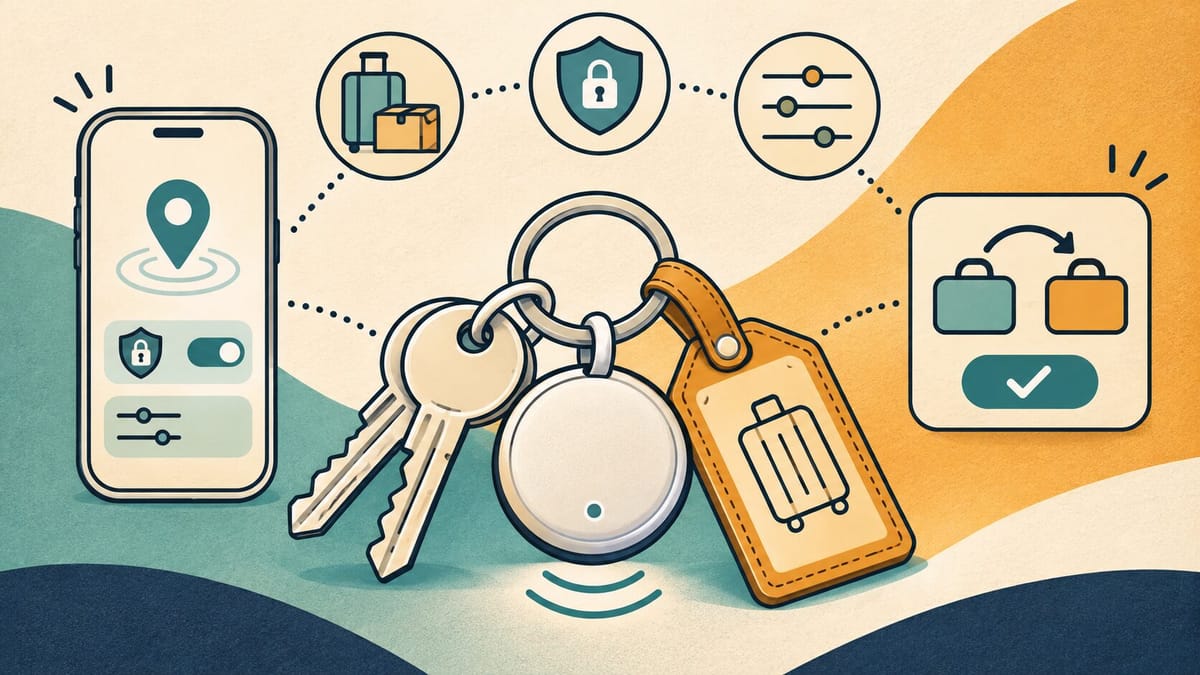
A tracker becomes a handover problem when an item changes hands
AirTags appeal because a small object can remain attached to the things people misplace or lend: a keyring, checked bag, camera case, tool kit, bicycle accessory, or vehicle key. The technical setup takes minutes. The ownership question can last much longer. A family member may borrow the bag. A colleague may take the kit on a job. A former housemate may still appear in the sharing arrangement. The item may be sold, returned, or left behind.
Apple's AirTag setup guidance makes the account relationship clear. The owner adds the device through Find My while signed into an Apple Account with Find My enabled. Apple also allows an owner to share an AirTag or other Find My item with another person, so a borrower can find it. Those capabilities create useful choices, although they also make a casual setup session a poor substitute for a clear agreement.
The accessible opportunity sits in a narrow preparation service. An operator can help an owner define the item, the account holder, the permitted user, and the return or removal route. The owner performs every account action. The operator records no credentials, monitors no locations, and never becomes a third party in the relationship.
This works as a service when the customer is paying for clarity around a real handover. A shopper seeking a tracker discount needs retail comparison, which is a different job. That distinction keeps the offer focused on a customer problem.
The item's owner, user, and return route should match
An AirTag belongs to a chain of control. The physical object has an owner. The tracker is registered to an account. The item may have a temporary user. The four can align neatly, or they can create friction when nobody knows who should remove access or take the next step.
An effective handover record has four parts.
Item. Describe the object in ordinary language and state why it carries a tracker. “Blue travel bag used by the household” is more useful than an unlabeled tracker on an account screen. The record should avoid serial numbers, travel plans, or live locations unless the owner needs them for their own records.
Owner. Name the person responsible for the account relationship and the physical item. A helper can ask the question, yet the owner must sign in and make any pairing, sharing, or removal choice themselves. This boundary protects credentials and makes later decisions easier to resolve.
Permitted user. Record whether another person may use the item and whether the owner intends to share access through the platform. A luggage case shared by partners has a different arrangement from a work kit issued to an employee or an item loaned to a friend. Consent should be clear and freely given. Silence, pressure, or an old household arrangement is a poor basis for a tracking relationship.
Exit. State what happens at return, sale, loss, or a change in the relationship. The owner checks the platform's current removal guidance, removes sharing where appropriate, and confirms the physical item is back under their control. A short exit step helps prevent an old tracker association from becoming an unpleasant surprise months later.
This four-part record is the useful analytical layer. It turns a hardware setup into a custody decision that the customer can revisit. It also reveals when the service should end: an unclear owner, disputed possession, or a person who feels unsafe requires a pause and referral.
Why privacy shapes the service more than the hardware does
Location trackers have legitimate uses, and they can also be misused. Apple publishes unwanted-tracking alerts and safety guidance for situations where an AirTag, Find My accessory, or compatible Bluetooth tracker may be moving with someone. Its guidance says that people who feel at risk should contact local law enforcement, which can request available information from Apple in support of an investigation.
That safety context creates a clear commercial boundary. A small provider should never install a tracker on behalf of someone who is absent, advise on covert tracking, retrieve location history, investigate a person, or decide whether a client's use is lawful. Rules on privacy, employment monitoring, family arrangements, and recording vary by country. A client with a legal or safety concern needs qualified local support or the appropriate authority.
The same boundary protects the provider from account-security problems. They should not request an Apple Account password, passcode, two-factor code, device PIN, recovery key, or location screenshot. They should not keep a copy of the handover record unless the client specifically asks for a client-controlled document and can store it safely. A template can guide the conversation without becoming a database of people's movements.
The service's value therefore comes from sequence and scope. The operator helps the owner ask the right questions before a tracker is attached, shared, or transferred. The owner remains the only person who can act on the account.
Apple's scale explains why resale is a weak starting point
Apple earns from the hardware and ecosystem around its devices. Its fiscal 2026 Form 10-K reports $35.577 billion in Wearables, Home and Accessories net sales. That is a broad category rather than an AirTag revenue figure, so it cannot be used to estimate tracker sales. It does show the scale of the established category that a small reseller would be entering.
Large retailers already have purchasing power, supply arrangements, payment systems, returns infrastructure, and a familiar brand. A new seller who buys a few trackers faces thin room between a retail price, delivery cost, payment fees, returns, and the time needed to answer setup questions. The tracker itself is easy to compare. A low-capital entrant gains little advantage from holding inventory.
The value chain has a more accessible layer. Apple and other manufacturers sell hardware. Retailers and marketplaces distribute it. Platform operators provide account and device services. Repair, luggage, travel, locksmith, and community-support businesses already meet people at moments when a physical item changes hands. A small operator can add a fixed-scope ownership and handover check to that last layer, provided the partner understands the privacy boundary.
That is a modest proposition. It sells preparation around a defined moment of confusion and avoids hardware inventory, account access, and payment handling.
A 75-minute offer needs a narrow scope to make economic sense
A practical appointment could include 45 minutes of owner-led discussion and setup review, 15 minutes to create the four-part record, and 15 minutes for an owner-led handover check. That is 75 minutes before travel time, insurance, booking administration, tax, and follow-up. Use that figure as a service-design calculation only. It does not set a recommended price.
The calculation explains why an open-ended “AirTag help” offer is difficult to sustain. Every unexplained account lock, device compatibility question, or family disagreement can turn a short booking into a long support case. A fixed scope gives the operator a way to price time honestly and gives the customer a clear outcome.
Three offers fit the model.
- A household shared-item handover session for keys, bags, sports equipment, or a family vehicle key. The client controls every account action and leaves with a private record.
- A referral-ready checklist for a luggage-repair shop, locksmith, travel adviser, or local technology helper. The partner identifies the handover question and sends the customer to a provider who has a written privacy policy.
- A short workshop for a community technology programme on attaching, sharing, returning, and removing item trackers. The workshop uses fictional examples and directs account-specific cases to official support.
Affiliate content can also fit when it helps readers compare tracker cases, battery-replacement tools, luggage labels, and compatible devices. Any commercial relationship needs a clear disclosure. Content should explain ownership, sharing, and safety limits instead of presenting a tracker as a cure for lost property or personal risk.
The first test should measure willingness to pay for clarity
The smallest sensible test is five referral-partner interviews before building a website or buying stock. Luggage-repair shops, locksmiths, travel advisers, local repair businesses, community digital-skills trainers, and household organisers may hear the same questions in different forms: who set this up, can another person see it, and how do we remove it when the item is returned?
Use a fictional bag or keyring in a 30-minute owner-led walkthrough. Ask each participant to identify the item, owner, permitted user, and exit step without sharing credentials or a live location. Then offer three paid pilots with a tightly capped scope. The client performs all sign-in, pairing, sharing, and removal actions while the provider explains the checklist.
The evidence threshold is simple. Continue only if at least two people pay for a session or one referral partner asks to use the service again. Stop if clients expect covert monitoring, access to private accounts, legal interpretation, or help during a live safety incident. A refusal at that point protects both the customer and the business.
The right operator has trust and a reason to stay narrow
This model suits a privacy-aware digital-skills trainer, an independent technology helper with a clear written policy, or a local service business that already works at the point of physical handover. It suits someone comfortable saying that an account decision belongs to the owner and that a safety issue belongs with qualified support.
Resellers looking for quick product margin, providers who need broad remote access to customer phones, and anyone who would market tracking as a way to supervise another person should choose a different field. Those paths produce more liability and less trust than the modest fee can support.
The small business case rests on repeatable questions, a trusted referral route, and disciplined scope. A generic setup tutorial is easy to copy. A provider who can make a household or business handover calmer, safer, and clearly documented has a more credible reason to be paid.
The best outcome is a record the owner can act on
AirTags create a real service angle when the item has a clear purpose and the people around it agree on control. The four-part handover record gives an owner a practical way to define the item, account holder, permitted user, and exit route before ambiguity turns into a problem.
For a small entrant, that is the right layer to test. Keep every credential and location inside the customer's control, use partners for referrals, and treat safety or legal uncertainty as a stop sign. The service earns trust through a clear handover and a narrow reach into private information.
Sources
- Apple: Add an AirTag to Find My
- Apple: Share an AirTag or other item in Find My
- Apple: Unwanted tracking alerts and safety guidance
- Apple: 2026 Form 10-K