Dividend Calendar Strategy: How Payment Months Can Shape Income Timing
Learn how dividend calendars work, why payment months rotate, and how investors can study monthly, quarterly, and semiannual payouts.

Why This Topic Matters
Dividend investing is often discussed as if the only important number is yield. That is a mistake. Yield matters, but timing matters too. A company may pay dividends monthly, quarterly, twice a year, once a year, or only when its board decides to approve a special distribution. Two stocks can have similar annual yields and very different cash-flow patterns.
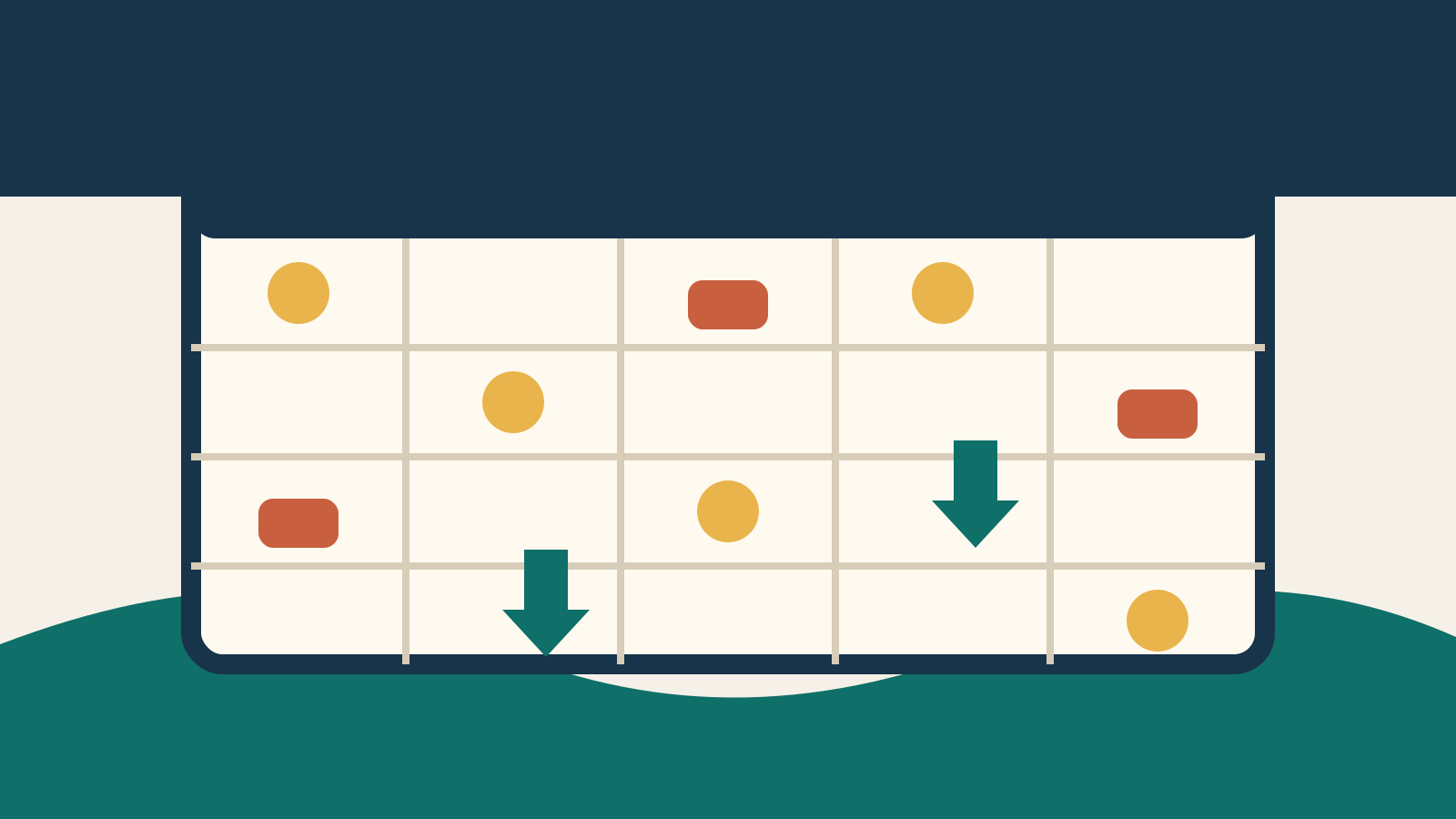
That is where a dividend calendar becomes useful. A dividend calendar is a simple map of when different holdings are expected to pay cash distributions. Some investors use it to understand when portfolio income might arrive. Others use it to avoid the false comfort of a high annual yield that pays at inconvenient times, depends on one company, or comes from a business with unstable earnings.
The idea can sound mechanical: find one stock that pays in January, April, July, and October; another that pays in February, May, August, and November; and another that pays in March, June, September, and December. Together, those three quarterly patterns may create cash payments every month. Add monthly payers or semiannual payers, and the calendar can become even smoother.
But the calendar is only an organizing tool. It is not a guarantee of income, safety, or return. Dividends can be reduced, delayed, suspended, or changed. Payment dates can move around holidays and business days. A well-built dividend calendar starts with business quality and payout sustainability, then uses timing as a secondary design choice.
This article is educational and global-first. Dividend rules, tax treatment, withholding taxes, account types, and shareholder rights vary by country, exchange, and investor residence. Readers should check local rules or speak with a qualified local adviser before making investment decisions.
The Core Idea
A dividend is a portion of company profit paid to shareholders. Investor.gov describes dividends as payments public companies often make on a fixed schedule, while noting that special or extra dividends can happen outside the normal rhythm.
The calendar depends on several dates. The declaration date is when the company announces the dividend. The record date determines which shareholders are on the company’s books for that payment. The ex-dividend date is the key trading-date concept: if an investor buys on the ex-dividend date or after, they generally do not receive the next dividend. The payable date is when the cash is scheduled to be sent.
For a calendar-minded investor, the payable date is the cash-flow date. The ex-dividend date is the eligibility date. Confusing the two is one of the easiest ways to misunderstand dividends.
The payment frequency is separate from the payment month. A monthly dividend stock may pay every month. A quarterly payer usually pays four times per year, often on a three-month cycle. A semiannual payer pays twice per year. Some companies pay annually. Others pay irregular dividends when cash flow, commodity prices, capital returns, or board decisions allow it.
The “every four months” idea usually appears when looking at quarterly payment cycles. A company that pays in January, April, July, and October is not paying every four months. It is paying every three months, four times a year. But from the investor’s point of view, each individual holding appears on the calendar once every quarter. Combine three different quarterly cycles, and the portfolio can show a payment in every month of the year.
The Background or History
Dividends are one of the oldest ways public companies return cash to shareholders, but payment customs vary by market. In the United States and Canada, many large companies pay quarterly. In the United Kingdom, Europe, Australia, and parts of Asia, semiannual or annual dividend patterns are more common, often tied to interim and final dividend declarations. Real estate investment trusts, business development companies, income funds, and some exchange-traded funds may pay monthly.
The payment schedule is ultimately a board-level decision. A company’s board approves the dividend amount, record date, and payment date. That means a historical pattern is helpful but not permanent. A company that usually pays in February, May, August, and November may shift by a few days because of weekends, holidays, exchange calendars, or administrative decisions. A company can also change its payout policy if profits, debt, regulation, or strategic priorities change.
That is why the best dividend calendars are updated from official investor-relations pages, exchange notices, fund documents, or broker data. A spreadsheet built from old assumptions can be neat and wrong at the same time.
How It Works in Real Life
Imagine an investor wants to understand the rhythm of dividend income without relying only on monthly payers. They might notice that many quarterly payers fall into one of three broad payment-month groups:
- January, April, July, October
- February, May, August, November
- March, June, September, December
These groups are not formal categories. They are patterns that often appear when companies pay quarterly. The exact date within the month can vary, and the pattern can change.
For example, as a U.S.-listed example, The Coca-Cola Company says in its shareholder FAQ that it normally pays dividends four times a year, usually on April 1, July 1, October 1, and December 15. That is a familiar quarterly rhythm, though it is not perfectly aligned with the January-April-July-October group because the winter payment is often in December.
Apple is an example of a quarterly payer whose recent dividend history shows payable dates clustered around February, May, August, and November. Its investor-relations dividend history lists regular cash dividends with payable dates such as February 12, May 14, August 14, and November 13 in recent cycles.
Chevron is an example of a quarterly payer whose recent dividend history shows payments around March, June, September, and December. Its investor-relations dividend table lists payable dates in those months across multiple recent years.
Monthly payers can fill the calendar differently. Realty Income, a U.S.-listed real estate investment trust, states that it pays monthly dividends and says payments have historically occurred on the 15th of the month or the next business day when the 15th falls on a weekend or holiday. Main Street Capital, a U.S.-listed business development company, also publishes regular monthly dividend tables on its investor-relations site.
Semiannual examples work differently. Coca-Cola Europacific Partners says it reverted to two interim dividends, with one payment before the end of June and another in December. A semiannual payer may be useful in a calendar, but it will not create monthly income by itself. It creates two larger calendar entries, not twelve small ones.
Here is a simplified illustration, using examples only and not recommendations:
- Monthly layer: Realty Income or Main Street Capital may create regular monthly entries.
- February-May-August-November layer: Apple has recently paid in this pattern.
- March-June-September-December layer: Chevron has recently paid in this pattern.
- April-July-October-December layer: Coca-Cola normally pays around these months.
- Semiannual layer: Coca-Cola Europacific Partners has described a June-and-December style rhythm.
An investor could mix companies from different schedules so that at least one holding is expected to pay in most months. But that does not mean the portfolio is diversified, safe, or suitable. A calendar with payments every month can still be risky if the holdings are concentrated in one sector, one currency, one country, or one fragile payout policy.
Practical Takeaways
Start with the business, then the calendar. A weak company that happens to pay in a convenient month is not automatically better than a stronger company that pays in a crowded month.
Build a simple spreadsheet with columns for ticker, company name, country or exchange, sector, dividend frequency, expected payment months, ex-dividend date, record date, payable date, dividend amount, currency, and source link. Use official investor-relations pages where possible.
Separate regular dividends from special dividends. Special dividends can be pleasant, but they should not be treated as dependable monthly income.
Use payment months as a cash-flow planning tool, not as a reason to overconcentrate. If every stock in the calendar is a bank, telecom, oil company, or property trust, the calendar may look diversified by month while being concentrated by business risk.
Remember that dividend income and total return are different. A company can pay a dividend while its share price falls. Another company may pay a smaller dividend but compound capital more effectively. The calendar helps with timing; it does not answer valuation or quality by itself.
Check tax and withholding rules. Cross-border dividends may face withholding tax, local reporting requirements, or different treatment depending on the investor’s account type and residence. Rules vary widely by country.
Risks, Limits, or Common Mistakes
The first mistake is chasing yield. A very high dividend yield may reflect a falling share price, business stress, or a payout investors do not believe is sustainable. The calendar should never be used to hide that risk.
The second mistake is buying only for the next dividend. Share prices often adjust around ex-dividend dates, and taxes or trading costs can make dividend-capture strategies unattractive. Investor.gov’s explanation of ex-dividend dates is a useful reminder that eligibility and economics are not the same thing.
The third mistake is assuming dates never change. Boards approve dividends, exchanges set trading calendars, and holidays can shift payment mechanics. Always verify upcoming dates before relying on them.
The fourth mistake is confusing payment frequency with income stability. Monthly payments can feel stable, but the underlying business still matters. Quarterly or semiannual payments can be perfectly normal in many markets.
The fifth mistake is ignoring currency. A global dividend calendar may include U.S. dollars, euros, pounds, yen, or other currencies. Exchange rates can change the value of income in the investor’s home currency.
Finally, avoid treating example stocks as a shopping list. Coca-Cola, Apple, Chevron, Realty Income, Main Street Capital, and Coca-Cola Europacific Partners are useful examples because their public dividend pages illustrate different calendar patterns. They are not personal recommendations.
Final Takeaway
A dividend calendar is a practical way to see when cash might arrive from a portfolio. Monthly payers can create a steady rhythm. Semiannual payers can add larger, less frequent entries. Quarterly payers can be mixed across different payment-month cycles so the portfolio shows dividends in many or even all months.
The smarter use of the calendar is not to force income into every month at any cost. It is to understand timing while still asking the deeper questions: Is the business healthy? Is the payout sustainable? Is the portfolio diversified? Are taxes and currency effects understood? Is the investor relying on dividends for spending, reinvestment, or simply tracking?
Used that way, a dividend calendar becomes more than a pretty grid. It becomes a calm planning tool that helps investors see income timing clearly without pretending timing is the same thing as safety.
Sources
- Investor.gov: Dividend
- Investor.gov: Ex-Dividend Dates
- The Coca-Cola Company: Shareowner FAQs
- Apple: Dividend History
- Chevron: Dividend Information
- Realty Income: Investor FAQs
- Main Street Capital: Dividends
- Coca-Cola Europacific Partners: Dividends