Electric Ratchets Earn Their Keep in Tight Spaces, Not on Every Fastener
An electric ratchet can remove the slowest part of repetitive fastening work. Its real value depends on knowing where powered speed ends and controlled final torque begins.

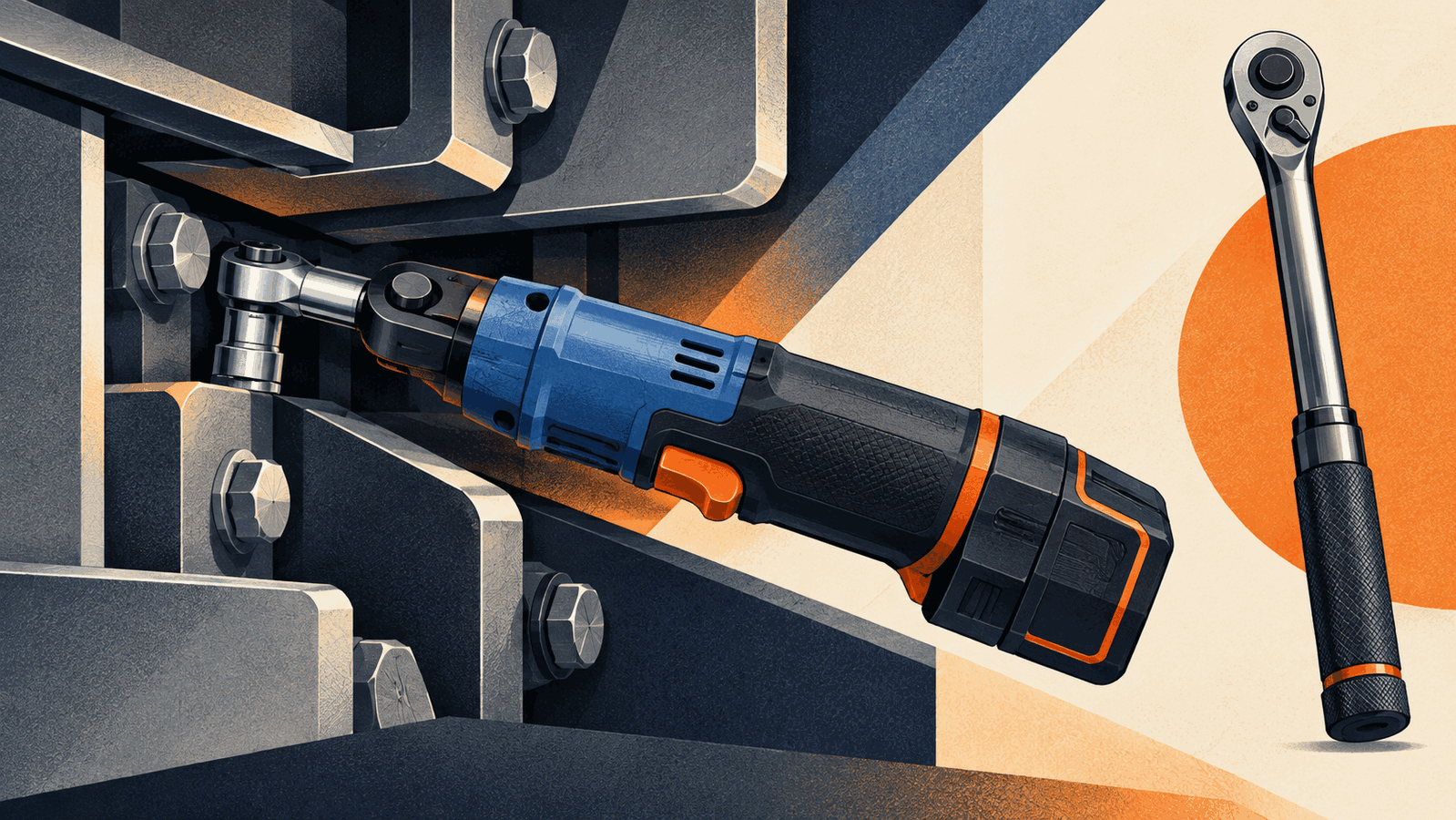
An electric ratchet looks like a modest upgrade to a familiar hand tool. For people working in an engine bay, beneath a sink, inside a cabinet, or around machinery, it can save the repetitive turning that makes small jobs slow and tiring. That practical benefit explains the interest in the category.
The business lesson is less obvious. An electric ratchet is valuable only after a user has selected the correct fastener, socket, access point, and final-tightening method. A small operator who understands that workflow can build a useful guide, task kit, or service. A seller who treats the tool as a generic high-torque solution invites returns, unsafe use, and disappointed buyers.
Electric ratchets speed repetitive rotation
An electric ratchet uses a battery-powered motor to turn a socket after the socket is seated on a fastener. Its compact head and short movement make it useful where a full-size drill, impact wrench, or long-handled manual ratchet has little clearance. Typical jobs include removing light fasteners, assembling brackets, servicing accessible components, and running nuts along a thread after they have been loosened.
The tool has a clear boundary. It is usually not the right first tool for a seized fastener, a wheel nut, or a fastener with a precise final specification. A manual breaker bar or another suitable method may be needed to loosen a resistant fastener. A calibrated torque wrench is the appropriate tool when an equipment maker specifies a final torque. The electric ratchet handles the time-consuming middle of the task.
Product specifications make the distinction visible. Milwaukee’s M12 1/4-inch ratchet is rated at up to 30 foot-pounds and 250 RPM. DEWALT’s 12V 1/4-inch ratchet lists up to 40 foot-pounds, a variable-speed trigger, and a compact head for confined applications. Buyers should treat those manufacturer figures as specifications for those individual products.
That creates a useful content angle: help buyers choose the tool by access and task sequence, rather than by the largest torque figure in a listing.
Where buyer confusion becomes a small opportunity
Most first-time buyers are trying to answer a practical question. Will this reach the bolt? Will the socket fit? Will it remove the fastener? Can it tighten it safely? Does the battery work with tools they already own?
The questions look similar, but they refer to different constraints:
- Drive size determines which sockets and adapters fit. A 1/4-inch drive suits smaller fasteners and tighter spaces; larger drives address other applications.
- Head clearance matters when the handle cannot swing through a full arc.
- Breakaway torque is the force needed to start a stuck fastener moving. It can be much higher than the tool’s powered output.
- Final torque is a controlled specification for the finished joint. It requires the relevant equipment specification and an appropriate torque tool.
- Battery platform affects the cost of entry, charger availability, and whether a buyer can share batteries across tools.
The most credible small-business role is a clear decision aid. A garage-equipment retailer, repair educator, or tool creator can publish task-specific guides such as “electric ratchet for interior trim work” or “how to choose a compact ratchet for bicycle workshop fixtures,” while stating the limits of the tool. An automotive workshop can bundle a tool recommendation with a socket checklist and a link to the vehicle maker’s service information. Each offer reduces an expensive error: buying a tool that does not fit the job.
The opportunity is strongest when the audience already has a defined type of repair work. General tool lists are crowded and price-sensitive. A guide built around one workflow, such as appliance installation, light fleet maintenance, or workshop fixture assembly, can earn attention because it resolves a more specific decision.
Why scale changes the category economics
Large tool brands benefit from more than a product catalogue. They sell batteries, chargers, compatible tools, warranty support, retail availability, training, and replacement parts. A new retailer cannot reproduce that system by stocking a few low-priced ratchets.
Techtronic Industries, the owner of Milwaukee and Ryobi, reported US$15.3 billion in sales for 2025, with a 41.2% gross margin across the group. The same report said Milwaukee and Ryobi both grew in local currency. Those figures describe the company as a whole, not electric ratchets or a particular battery platform. They show why established makers can spread product development, distribution, warranty, and battery-platform costs across a large installed base.
For a small entrant, that scale changes the sensible position in the value chain. The accessible work is education, selection, upkeep, and task preparation. It may also include a carefully managed local rental or workshop-kit service, provided the operator has appropriate insurance, inspection procedures, safety instructions, and local legal compliance. Selling unverified tools from an unknown supplier on paid ads is the weak end of the category: trust is low, returns are costly, and product-support obligations arrive after the sale.
The economics reward a narrower offer
An electric ratchet is more expensive than a basic hand ratchet and cheaper than many professional diagnostic or lifting tools. That middle price can support a referral, retail, or service model, but it does not make every acquisition channel sensible.
Consider a simple planning scenario for a curated task kit. Suppose an operator sells a compatible ratchet, two sockets, and a short printed setup card for 120 currency units. If the combined landed product cost is 82, payment processing and packing cost 8, and the contribution before marketing, returns, warranty handling, tax, and overhead is 30, the arithmetic is 120 minus 82 minus 8. The gross margin on the product is 31.7% before those additional costs, calculated as 38 divided by 120.
That contribution disappears quickly if a customer returns a kit because the drive size was wrong or the ratchet could not loosen the expected fastener. The decision rule is therefore simple: sell a narrow kit only when the task, fastener range, socket sizes, and clearance needs are known well enough to prevent a high rate of mismatches. If the seller cannot state those conditions plainly, a guide or referral page is the lower-risk first step.
This is a form of defensibility that a price comparison cannot easily copy. A compatibility checklist, original workshop photographs, a documented fit guide, and responsive local support can make the choice safer for a buyer. Accuracy, evidence, and responsive support create a modest moat.
Build the offer around the work sequence
A useful electric-ratchet offer should describe the sequence of work rather than promising that the tool solves every fastening problem. A maintenance-oriented package can be structured around four moments:
1. Identify the fastener and access. State the socket drive, expected clearance, and whether the work area needs additional light or an extension.
2. Break loose safely. Explain that a stuck fastener needs an appropriate manual or specialist method before powered turning begins. Do not encourage force beyond the tool maker’s instructions.
3. Run the fastener. Show where an electric ratchet saves time after the fastener moves freely.
4. Finish to specification. Direct the user to the equipment maker’s procedure and a suitable torque wrench where final torque matters.
The U.S. Occupational Safety and Health Administration’s hand and power tool guidance advises users to maintain tools, secure work where possible, keep bystanders clear, and follow the manufacturer’s instructions. Those are U.S. workplace materials, yet the underlying operating principles are broadly useful. A local operator should also follow the safety, consumer, electrical, rental, and insurance rules that apply where they work.
The format can be a paid workshop handout, a mechanic-reviewed content series, a product-selection consultation, or an add-on to a local repair service. The correct model depends on the audience. A professional workshop may value time savings and organized tool access. A home repair audience may value confidence and avoiding a purchase that gathers dust.
A low-cost test before stocking tools
Start with one narrowly defined task and ten buyer conversations. For example, ask independent repairers or experienced hobbyists how often they remove small fasteners in low-clearance spaces, which ratchet and socket sizes they use, and where they lose time. Build a one-page guide that maps their answers into a clear task sequence.
Offer the guide free in exchange for feedback, or sell a small number of pre-validated kits only after confirming the target equipment and tool requirements. Track four measures: questions per buyer, time to make a recommendation, clicks to a recommended product, and the share of buyers who report a successful first use. Do not begin with a large order or broad paid advertising campaign.
The test fails usefully when users ask for incompatible tasks, demand high breakaway force, or require formal repair work outside the operator’s competence. Those signals point toward referral partnerships, education, or a different service rather than more inventory.
What to avoid
Avoid presenting an electric ratchet as a substitute for a torque wrench, impact wrench, or professional diagnosis. Avoid publishing universal torque advice, modifying batteries, selling untraceable electrical tools, or recommending use around energized equipment without qualified guidance. Do not assume that a tool recommendation transfers across vehicle, appliance, or machinery models.
The category is also a poor fit for operators who need immediate cash flow from anonymous product listings. The buyer needs enough trust to act on a task-specific recommendation, and that trust takes evidence, clear limits, and support. A person with repair experience, a focused audience, or access to a local workshop has a more credible starting point.
The practical judgment
Electric ratchets can create genuine value by reducing repetitive motion in constrained work. The strongest small opportunity sits around correct task selection: show the buyer where the tool works, what must happen before it is used, and how the fastener should be finished. Prove that guidance with a small, documented test before carrying inventory.
Sources
- Milwaukee M12 cordless 1/4-inch ratchet specifications
- DEWALT 12V brushless 1/4-inch ratchet specifications
- Techtronic Industries annual report 2025
- OSHA hand and power tool safety guidance