Replacement Water-Bottle Lids: The Small Parts Market Where Fit Matters Most
A lost cap can turn a durable bottle into a daily inconvenience. The useful opportunity sits in helping buyers identify a safe, compatible replacement before a low-priced part becomes a costly return.

Lost lids, chewed straws, worn seals, and cracked flip tops create a simple consumer problem: a usable bottle becomes awkward to carry or impossible to trust. Replacement parts offer an obvious answer, and major drinkware brands sell them. Yet the apparent simplicity hides the decision that determines whether a small operator can earn from the category: can the buyer identify the exact part that fits, arrives safely, and does the job they expect?
That makes replacement water-bottle lids a stronger service, content, or compatibility opportunity than a broad inventory play. A seller who treats every cap as interchangeable takes on returns, support work, and safety complaints. A specialist who reduces fit uncertainty can create useful value before a product changes hands.
A durable bottle still has vulnerable parts
Insulated bottles and tumblers are designed to stay in use for years, but their lids have moving pieces, seals, hinges, straws, and threads. Those are the components most likely to be misplaced, damaged, or difficult to clean. The bottle body may remain sound while the drinking mechanism becomes the reason a customer considers replacing the whole item.
Brand catalogues show that this is a defined product category rather than an improvised workaround. Hydro Flask lists caps, straw packs, and press-in lids, separating Standard Mouth and Wide Mouth products and specifying limits such as cold-drink-only use for its straw and chug caps. YETI’s drinkware accessories catalogue includes replacement lids, sliders, caps, and straws across several Rambler formats. Stanley 1913 also sells replacement parts and accessories, including lids and straws.
The visible item is a lid. The economic need is confidence. A parent does not want a leaking bottle in a bag. A commuter does not want a replacement that prevents the cup from fitting a vehicle holder. A customer who uses hot drinks needs more than an attractive straw lid. These are small failures with immediate consequences, which creates a real reason to seek help.
Compatibility is the central service
The useful unit of work is not “sell a lid.” It is “identify a compatible lid for this bottle and use case.” That distinction changes the business model.
Compatibility has several layers:
- The bottle’s brand, product family, production generation, and capacity can matter.
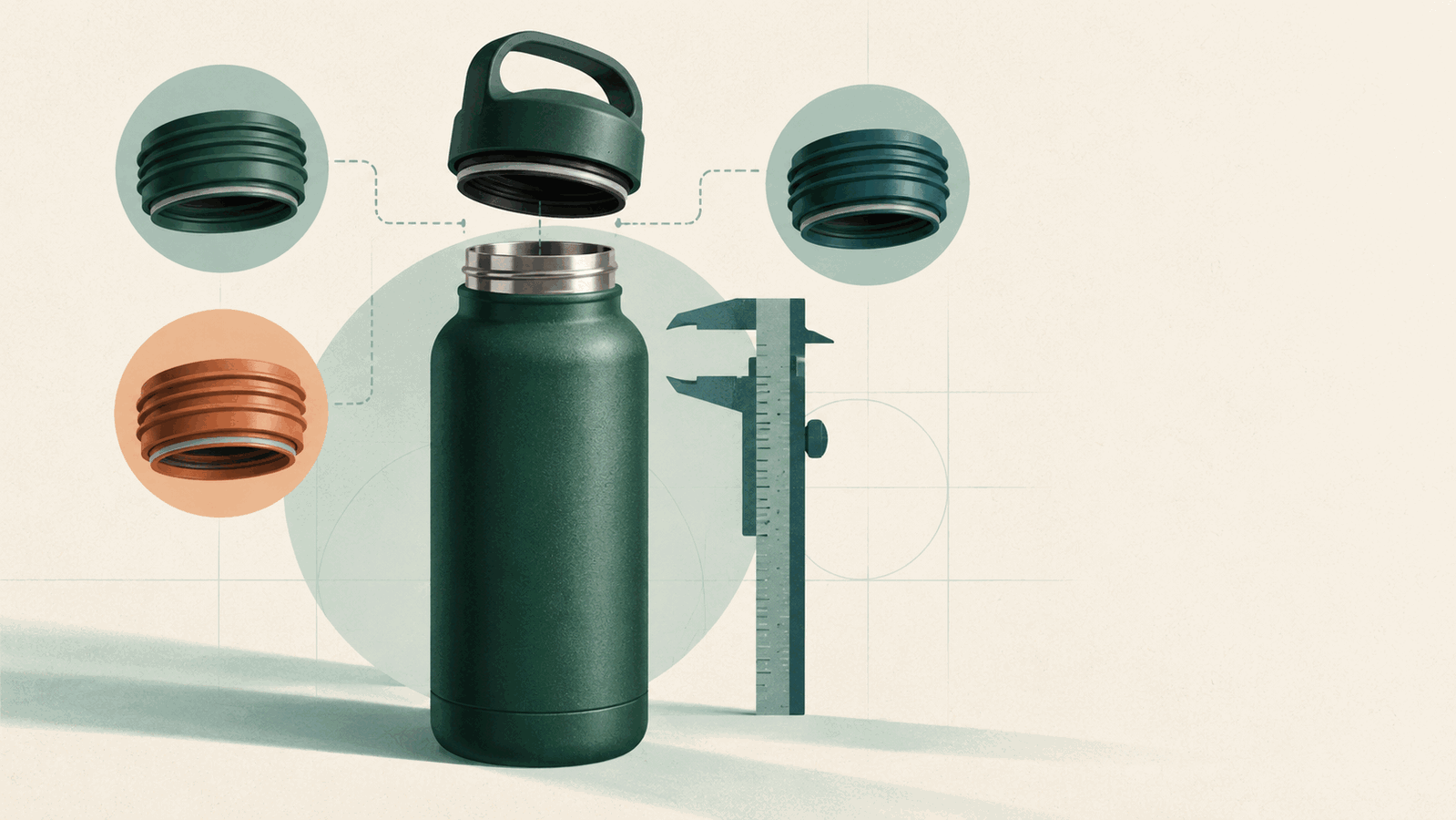
- The mouth diameter, thread direction, thread profile, and rim shape determine whether a cap seats correctly.
- A press-in tumbler lid, a screw cap, a straw lid, and a travel-mug lid perform different jobs.
- Hot drinks, carbonated drinks, children’s use, and carrying in a bag create different safety and leak expectations.
- A replacement seal or straw may be the correct low-cost fix when the lid itself is intact.
Hydro Flask’s own guidance illustrates the problem. It distinguishes its Standard Mouth and Wide Mouth bottles by opening shape and threading, and says its straw caps are intended for cold drinks. Those details are ordinary product information, yet they are exactly the details that get lost in a broad marketplace listing.
For a small operator, a compatibility record can be more valuable than a large shelf of parts. A practical record starts with a photo of the bottle and its base, an opening measurement, the original lid type, the intended drink temperature, and any known product code. The result can be a buyer guide, a short pre-purchase questionnaire, a local fitting service, or a carefully scoped online catalogue.
Where established companies capture the value
Large brands have advantages that a small reseller cannot cheaply recreate: product specifications, approved suppliers, warranty processes, distribution, and the ability to make an exact part available alongside the original product. Their accessory catalogues also turn a one-time bottle sale into later transactions for caps, straws, handles, and other additions.
Helen of Troy owns Hydro Flask as part of its Home & Outdoor portfolio. Its fiscal 2026 annual report reported $832.9 million in Home & Outdoor net sales, a segment that includes Hydro Flask and other brands. The company does not disclose replacement-parts or Hydro Flask-only sales in that segment figure. It still shows the scale of the ecosystem in which accessories sit: the brand owner earns from a broad portfolio, retail distribution, and direct sales rather than from a single low-priced component.
The small entrant therefore needs a narrower job. Useful positions include explaining fit, surfacing official parts, organizing replacement requests for a local retailer, or bundling a verified lid with cleaning guidance and a replacement seal where permitted. Manufacturing a lookalike part for a branded vessel is a very different business, with intellectual-property, food-contact, quality-control, and liability risks.
A unit-economics decision rule
Low unit prices can create an illusion of easy margins. Official examples show the range: Hydro Flask lists several caps around $9.95 to $14.95, while YETI lists several replacement accessories at $10 to $15. A small seller may see room between a wholesale cost and a retail price. The remaining amount has to cover much more than the part.
Consider a deliberately simple test case. If a verified replacement lid sells for $14, and the landed part cost is $6, the gross spread is $8. Deduct a hypothetical $1 payment fee and $1.50 for packing and fulfilment time or materials, and the contribution before customer acquisition, returns, overhead, and tax is $5.50. The calculation is $14 minus $6 minus $1 minus $1.50. It is a planning example rather than a market quote.
One avoidable return can erase the contribution from several correct orders once return shipping, replacement dispatch, support time, and unsellable packaging are counted. The more useful operating ratio is correct matches per support hour: a small catalogue becomes viable when the same documented matches recur and the answer becomes faster each time. That is why a generic listing competes mainly on price, while a verified-fit offer competes on avoided waste and avoided hassle.
The strongest early model is usually content or assisted matching. A detailed page about a particular bottle family can earn referral income where a legitimate program exists, collect qualified leads for a repair shop, or direct buyers to official parts. A local retailer can offer a small fitting appointment or an add-on service at the point of sale. An inventory-led store becomes more attractive only after repeat requests reveal a small number of high-confidence parts with stable supply.
A sensible first offer: the bottle-lid match check
A newcomer can test the need without buying a wall of accessories. Offer a “bottle-lid match check” for one narrow range, such as common wide-mouth insulated bottles in a single local market. Ask the customer to provide the bottle’s full photo, opening measurement, original lid image, use case, and country. Reply with one of three outcomes: an official part link, a verified compatible option with stated limits, or a recommendation to contact the manufacturer.
This test reveals the most important commercial facts within a small sample:
- Which brands and lid failures appear repeatedly.
- Whether customers will provide enough information for accurate matching.
- Whether they value a quick answer, a fitted part, or merely a link to the official store.
- How much support a single request requires.
- Which parts are too variable or safety-sensitive to recommend.
Set a cap before beginning. For example, handle ten requests manually, spend no more than the cost of a basic measurement tool and sample parts, and record the time needed for each correct recommendation. A useful signal is repeatable demand for the same two or three part-and-bottle combinations. Ten unrelated requests for obscure models signal a research problem, not an inventory opportunity.
What deserves caution
The category involves more risk than its size suggests. A lid advertised as leakproof can create a damaging claim if it fails in a bag. A part used with a hot drink can create a burn risk. Food-contact materials, product recalls, brand names, and marketplace rules vary by country and platform. Sellers should use manufacturer compatibility information where possible, preserve supplier records, state the model and use limitations plainly, and avoid claims they cannot substantiate.
Stanley’s recall information for selected travel-mug lids demonstrates why component-specific accuracy matters: the company instructed affected customers to stop using certain lids and offered a replacement designed for the existing product. A reseller or publisher should link to the relevant official safety notice rather than substitute an unverified part into a recall situation.
Counterfeit and untested accessories create another boundary. The low-risk route is original equipment parts, clearly identified aftermarket items from traceable suppliers, or information services that help a buyer choose between available options. Avoid implying a commercial relationship with a brand, using its marks as if authorized, or representing an aftermarket part as equivalent to an official one.
Who has a realistic opening
This opportunity suits a careful product researcher, repair shop, outdoor retailer, specialty kitchen retailer, or creator who already serves a defined bottle-owning audience. It rewards accurate records, patient support, clear photographs, and a willingness to turn away ambiguous requests.
It is a poor fit for anyone seeking quick turnover from a generic dropshipping catalogue. The small ticket size leaves little room for paid acquisition, customer-service mistakes, and international returns. A broad catalogue also makes it harder to maintain correct compatibility information as product ranges change.
The practical judgment
Replacement water-bottle lids reveal a genuine maintenance market, but the opportunity is not the plastic or steel component alone. Buyers pay for a reliable fit and a clear answer about use, safety, and availability. Start by becoming useful at matching. Build inventory only when the records show repeated, verifiable demand for specific parts.
Sources
- Hydro Flask caps and lids catalogue
- YETI drinkware accessories catalogue
- Stanley 1913 accessories and replacement parts
- Helen of Troy fiscal 2026 annual report
- Stanley 1913 recall information