Silicon-Carbon Batteries: Why the Real Business Is in the Anode Supply Chain
Silicon-carbon batteries promise faster charging and more energy from familiar lithium-ion cells. The harder and more valuable work is making a swelling-prone material dependable enough for factories, vehicle programs, and long supply contracts.

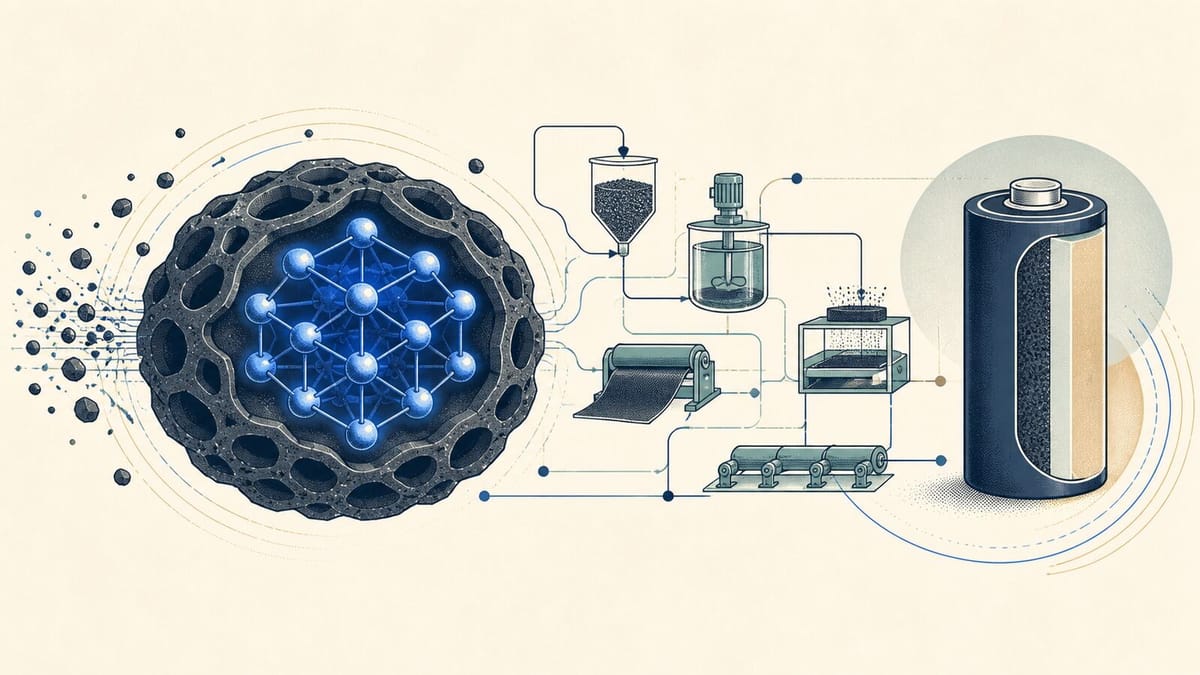
The battery breakthrough is not the whole business case
Silicon-carbon batteries attract attention because silicon can hold far more lithium than graphite, the conventional anode material in most lithium-ion cells. That makes a familiar promise possible: more energy in the same space, faster charging, or some combination of the two. But a material property is not yet a durable business.
The central commercial question is whether a supplier can make silicon work repeatedly inside a cell, at factory scale, with acceptable cycle life, cost, quality control, and customer qualification. MarketLens' conclusion is that the most defensible value sits less with a generic consumer battery brand and more with the companies that can turn silicon into a qualified, repeatable anode material and integrate it into existing cell production.
That conclusion is specific enough to test. If silicon-carbon products remain confined to small, premium applications despite material suppliers reaching reliable volume, the thesis weakens. If materials producers win long production programs while many downstream brands use similar cells, the thesis strengthens.
Why silicon needs a manufacturing solution
An anode stores lithium while a battery charges. Graphite has become the standard partly because it is stable and well understood in high-volume production. Silicon brings higher theoretical capacity, but it also expands and contracts sharply as it takes up and releases lithium. That movement can damage particles, disrupt the electrode, consume lithium through side reactions, and shorten useful life.
The commercial product is therefore not elemental silicon in a catalogue. It is a material architecture that manages expansion, electrolyte contact, particle consistency, coating, electrode formulation, and cell validation. Group14 describes its SCC55 material as a carbon scaffold with silicon and internal void space, while Sila describes automotive-grade manufacturing systems and quality processes for its Titan Silicon material. These are supplier descriptions, not independent performance rankings, but they point to the same economic fact: processing know-how is part of the product.
This changes who bears risk. A device maker may buy a cell. A cell maker must validate the anode against its chemistry, equipment, safety requirements, and warranty obligations. The anode-material supplier must prove batch consistency and scale. Each layer can earn revenue, but each layer also faces a different failure cost.
A 10 GWh plant puts the material business in perspective
In March, Group14 said its Sangju facility was designed for 2,000 metric tons of silicon battery material a year and about 10 GWh of battery capacity as production ramps. It also said one tonne of its material can replace roughly five tonnes of graphite, a company-specific estimate rather than an industry conversion factor. Its production announcement supplies the inputs for a useful normalization.
| Derived comparison | Inputs | MarketLens calculation | What it suggests |
|---|---|---|---|
| Silicon-carbon material per unit of stated battery capacity | 2,000 tonnes and 10 GWh | 2,000,000 kg / 10,000,000 kWh = 0.2 kg per kWh | A small mass of specialized material can influence a large amount of cell capacity. |
| Potential graphite displacement at the stated capacity | 2,000 tonnes of SCC55 and Group14's 5:1 replacement estimate | 2,000 × 5 = up to 10,000 tonnes | Supply-chain exposure can matter alongside energy-density claims. |
The table does not establish an industry-wide bill of materials, a selling price, or a profit margin. It simply makes the disclosed claims comparable. The important insight is that a material supplier can be strategically important without owning the whole battery pack: a modest mass input can affect charging, energy density, sourcing, and factory qualification across many kilowatt-hours of output.
That is why scale announcements deserve more scrutiny than a demonstration-cell headline. A performance result may prove technical possibility. Repeated output at stated capacity starts to test process economics and customer confidence.
Where the value chain can capture value
Silicon-carbon batteries do not create one new market so much as they redistribute work inside the lithium-ion value chain.
| Layer | What it provides | Main economic constraint | Likely source of durable value |
|---|---|---|---|
| Silicon-carbon material | Engineered anode powder or composite | Yield, purity, consistency, intellectual property, scale | Qualified process and long customer validation cycles |
| Electrode and cell maker | Coating, cell design, testing, production | Compatibility, cycle life, safety, capital equipment | Integration knowledge and manufacturing reliability |
| Pack and device maker | Product performance and warranty | Heat, charging behavior, user expectations, recalls | Product design, distribution, brand, service |
| Specialist service provider | Testing, materials analytics, traceability, qualification support | Credibility and technical capability | Solving a costly validation or compliance problem |
The first two layers carry the most silicon-specific risk. They also have the clearest reason to build a moat: a substitute material must work in the customer's process, not merely in a laboratory cell. Group14 says its material can fit several cell formats and chemistries, and Sila says its Moses Lake site is designed for automotive-scale output. Those claims still need to be evaluated customer by customer, but they explain why compatibility is commercially valuable.
Amprius offers a useful public-company contrast. Its 2025 annual report reports $71.6 million in battery-product revenue and $71.9 million in customer revenue, while also reporting access to more than 2.0 GWh of SiCore production through manufacturing supply agreements. The filing also records a $19.1 million impairment connected with a planned Colorado facility as the company shifted toward contract manufacturing. That is evidence that commercial scale can be pursued through partnerships rather than owned factories, but it is not evidence that nominal capacity is fully used or profitable.
The distinction matters for investors, suppliers, and founders. Access to gigawatt-hours is an operating option. It is not the same as shipments, revenue per kilowatt-hour, gross margin, or a secure long-term customer program.
The evidence supports a narrow opportunity, not a consumer gold rush
The sensible small-business conclusion is restrained. Starting a generic store, affiliate site, or battery brand around the phrase "silicon-carbon battery" is unlikely to solve a meaningful customer problem. Buyers of phones, vehicles, drones, or energy systems care about range, charging time, safety, warranty, and price. They rarely need a separate intermediary to explain anode chemistry.
There may be narrower opportunities for technically credible operators. Battery-test labs can help compare charge retention and thermal behavior. Materials and quality consultants can support supplier qualification. Specialist publishers can explain which performance claims come from cell-level tests, which come from pack-level products, and what cycling conditions were used. Procurement and traceability tools may become useful where manufacturers need to document material origin or diversify graphite exposure.
The decision rule is simple: pursue an opportunity only when it reduces a verified cost of qualification, testing, sourcing, or performance uncertainty for a defined buyer. Avoid businesses that depend on repeating a chemistry claim without access to product data, testing capability, or a distribution advantage.
What would disprove the optimistic story
Silicon-carbon materials still face ordinary industrial risks. A supplier can show strong energy density yet struggle with yield, cost, cycle life, safety, or customer-specific production conditions. A cell maker can gain performance while accepting a more demanding supply chain. A device company can decide that lower cost or longer warranty life matters more than an incremental specification gain.
The strongest validation is not a marketing claim or a search term. It is a repeatable pattern of qualified material shipments, disclosed customer programs, stable cell performance under relevant conditions, and economics that survive scale-up. For readers assessing a company or a business idea, the useful question is: what has been proven outside the lab, and which costly step remains unproven?
A practical research test is to put each supplier claim into one of three columns: laboratory result, customer validation, or production evidence. A claim belongs in the final column only when the source identifies operating capacity, recurring shipments, a named program, or comparable evidence. This prevents an impressive technical result from being mistaken for a finished industrial business.
Final takeaway
Silicon-carbon batteries are best understood as a manufacturing and supply-chain story disguised as a battery-specification story. Their upside comes from solving a hard materials problem inside established cell factories. The attractive positions are likely to be those that own a qualified process, reduce integration risk, or make performance claims testable. The weak positions are generic resellers and commentators with no role in that work.