Why Vending Machines Look Like Easy Money, and Often Aren't
A vending machine is visible, self-service, and easy to imagine as passive income. The difficult part sits out of view: finding a location with enough repeat demand to cover stock, payments, travel, repairs, and the operator's time.

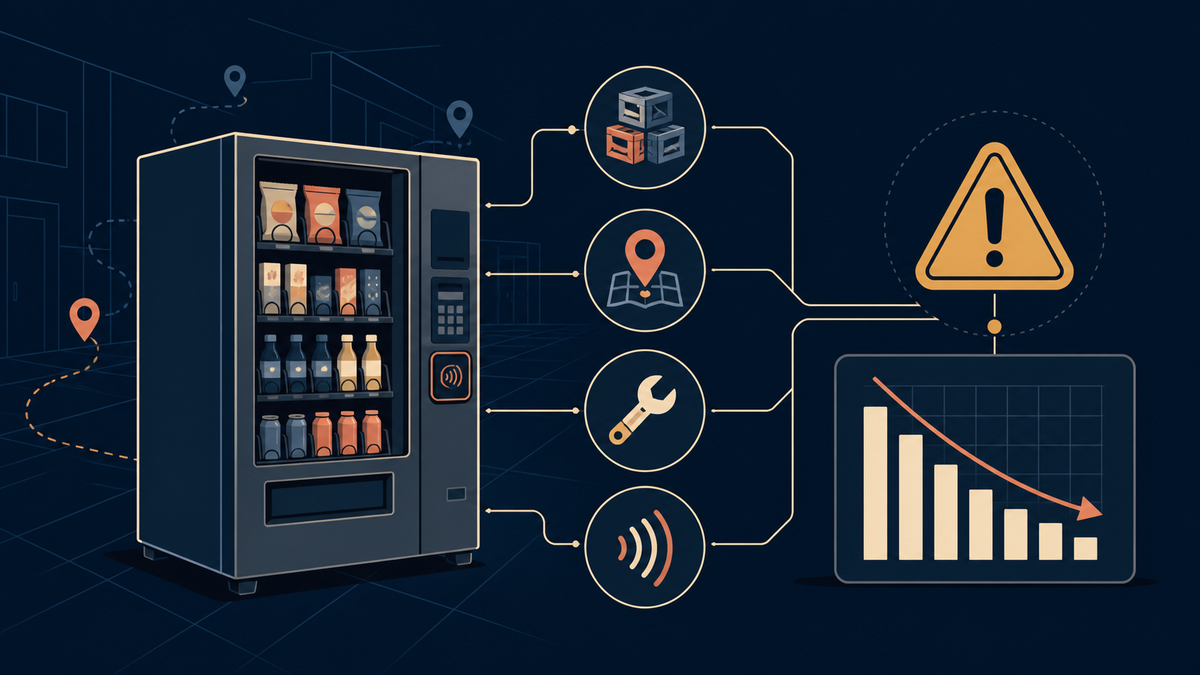
Vending machines look like a clean answer to a familiar question: what small business can earn while nobody is standing behind a counter? The machine takes payment, releases a product, and appears to keep working after the operator leaves. That picture is incomplete. A vending machine is a small retail outlet with a narrow product range, a fixed location, a replenishment route, payment costs, food-safety obligations where food is sold, and no salesperson to rescue a bad site.
The real business is not buying a machine. It is securing and serving a location that produces repeat purchases reliably enough to justify the machine, stock, travel, and attention it consumes. For a newcomer, that makes vending a location-validation business before it becomes an equipment business.
A machine can sell without creating a viable route
The customer who pays is the person buying a drink, snack, or other item. The location host may receive an amenity for staff or visitors, a commission, rent, or simply the benefit of having fewer requests for refreshments. The operator receives the sale, then pays for the product, payment acceptance, the machine, electricity where applicable, maintenance, insurance, travel, and sometimes a share of revenue to the host.
That chain explains the central trap. A machine can make occasional sales and still be a poor business. One low-volume machine may require the same journey, cleaning, expiry checks, payment troubleshooting, and repair response as a stronger location. A route becomes healthier when several nearby machines can be stocked and checked in one visit. That is service density, and it is harder to buy than a cabinet with shelves.
The market has moved away from the simple coin-operated image, too. Cantaloupe, a public provider of cashless payments and operations software for self-service retail, reported that cashless payments represented 71% of food-and-beverage vending sales in its 2024 United States and Canada dataset. Its 2025 annual report describes a business with subscription, transaction-processing, and equipment revenue. It reported US$302.5 million of revenue and US$3.4 billion of transaction volume for its financial year ended June 2025. Those figures do not prove that an individual machine will be profitable. They show why a modern operator must think about payments, device connectivity, inventory data, and route management as operating costs and capabilities, not optional extras.
The first calculation is sales capacity, not machine price
An equipment seller can quote a purchase price. That does not answer the more important question: can this exact site generate enough gross profit every month to cover the unavoidable costs?
The following illustration uses Cantaloupe's reported US$2.11 average vending ticket for 2024. It is not a forecast, a universal price, or a profit estimate. It simply turns a daily transaction count into a monthly sales figure before product cost, payment fees, host commission, machine cost, repairs, travel, and tax.
| Paid purchases a day | Assumed average ticket | Sales in 30 days |
|---|---|---|
| 8 | $2.11 | $506 |
| 15 | $2.11 | $950 |
| 25 | $2.11 | $1,583 |
The method is transparent: daily purchases multiplied by average ticket multiplied by 30 days. A reader should replace both inputs with local observation and local prices. The useful conclusion is not that 15 or 25 sales is enough. It is that gross sales can remain modest even when a machine looks busy, and every cost still comes out of that amount.
Before buying, write down the site's monthly gross-sales threshold using a simple formula: fixed monthly operating costs divided by the gross-profit percentage remaining after wholesale stock. Then add a realistic allowance for payment fees, commissions, travel, repairs, and the operator's time. If the site has no credible path to that threshold, a lower purchase price does not repair the case.
This is MarketLens' practical test of the "easy money" claim. The machine can be self-service for the buyer, but it is not self-managing for the owner. A machine that earns a little can create a job with poor hourly economics if it is far away, unreliable, or understocked.
Location is an operating asset, not free floor space
The strongest locations have a repeat reason to be there and a reason to buy without leaving. Shift workers, campuses, factories, clinics, accommodation sites, transport waiting areas, and workplaces can have those traits, but a category label is not enough. A quiet office may have free coffee and food deliveries. A busy-looking lobby may have visitors who do not wait long enough to buy. A gym can have strong demand for drinks but a strict product or exclusivity policy.
A useful location review asks practical questions:
- How many people pass the machine during the times it can be used?
- Are they waiting, working long shifts, or able to leave easily for food and drink?
- What substitutes already exist, including free refreshments, nearby shops, and delivery apps?
- Who approves the placement, electricity, access hours, stock deliveries, and removal of the machine?
- Is the site asking for rent or a commission, and what service level will it expect in return?
- Can the machine join another nearby service stop, or does every visit require a special trip?
The host is not merely a landlord. The host controls access to the demand that makes the machine valuable. A clear written agreement should set out access, electricity, responsibility for damage, removal rights, commission or rent, product restrictions, service expectations, and notice. The exact contract and consumer rules vary by country, so use local legal advice for terms that affect liability or rights.
Food, payments, and maintenance make the quiet work visible
Food vending is not outside retail rules because no staff member is at the point of sale. Ireland's Food Safety Authority says the vending operator is ultimately responsible for food safety when it controls stock management. Singapore's food agency similarly requires licensing for some higher-risk food vending and specifies conditions around matters such as temperature and operator contact information. These are country-specific examples, not a universal checklist, but they demonstrate the broader point: product handling, labelling, cleaning, temperature control, permits, tax, and consumer obligations need local verification before a machine is stocked.
Cashless payments add a second layer of responsibility. They can make a machine more convenient, but they also introduce transaction charges, connectivity, device support, and customer complaints when a payment succeeds but the product does not drop. A cashless reader is not a magic revenue upgrade. It is a system that has to be priced into the offer and tested in the actual building.
Maintenance is equally decisive. A jammed coil, refrigeration fault, blocked bill acceptor, or broken card reader converts a sales point into a complaint generator. Large operators spread these problems across technicians, warehouse stock, route software, and many locations. A small entrant should not pretend to copy that scale. The accessible advantage is narrower: respond quickly in one compact area, choose simple products, keep a basic service log, and remove slow sellers before they become waste.
Where a small entrant can realistically participate
Buying and operating a conventional snack route is one path, but it is not the only one and it is rarely the safest first move. Three narrower models can be more realistic.
- A location-validation service can help an existing vending operator or property manager assess footfall, nearby substitutes, service access, product fit, and whether a proposed site belongs on an existing route. The buyer pays for a clearer placement decision, not a promise of sales.
- A specialised refill or machine-care service can serve an established route in one local area, if the operator has the necessary food-handling, insurance, and equipment knowledge. The customer pays for reliable availability and cleaner service records.
- A focused placement partnership can find one type of site for an experienced local operator, earning a fixed introduction fee only where local law and a written agreement allow it. The operator keeps the machine and operating risk; the small entrant proves demand by finding sites that meet a defined profile.
These are not effortless businesses. They depend on trust, local relationships, and operational discipline. They do, however, avoid the mistake of buying inventory and metal before anyone has established that a site deserves it.
The smallest sensible test is a location audit
Do not begin with a row of machines, a warehouse lease, or a broad promise of passive income. Pick one local setting and conduct a two-week location audit with the owner's permission. Count relevant footfall at different times, map alternatives within a short walk, ask the host what people request, confirm access and electricity, and write down product restrictions. If possible, ask a local established operator whether the site fits its route criteria rather than assuming your own estimate is enough.
The next step is a non-binding indication of interest or a short, locally appropriate trial arrangement, not a long lease. A credible stop rule is equally important: walk away if the host will not allow reliable access, the customer mix is sporadic, the expected sales cannot clear a conservative monthly threshold, or the site creates a special journey outside a compact route.
For a reader who still wants to operate a machine, a single compliant trial at a site with documented demand is a better test than purchasing several units. Keep the product range simple, track every sale, stockout, refund, service call, journey, and discarded item. The evidence you need is not whether a few people like having a machine. It is whether the location creates repeat gross profit after the full cost of serving it.
The practical judgment
Vending machines look easy because the transaction is automated. Their economics are difficult because demand, location access, stock, technology, and maintenance are not. The most attractive opportunity for a newcomer is usually not to buy a machine cheaply and hope. It is to prove one location's repeat demand, then decide whether the machine belongs on a compact and serviceable route.
Pursue the idea if you already understand a specific local customer group, can serve sites close together, and can test one placement without relying on optimistic sales claims. Watch it if you can build a useful placement or service relationship with an established operator. Avoid it if the plan begins with debt, several machines, or a location that only seems busy from the pavement.
Sources
- Cantaloupe 2025 annual report
- Cantaloupe 2025 micropayment trends report
- Food Safety Authority of Ireland: Vending machines
- Singapore Food Agency: Food retail licence and permit requirements
- U.S. FDA Food Code Reference System