Cryptocurrency vs CBDC: The Difference Between Private Crypto and Digital Central Bank Money
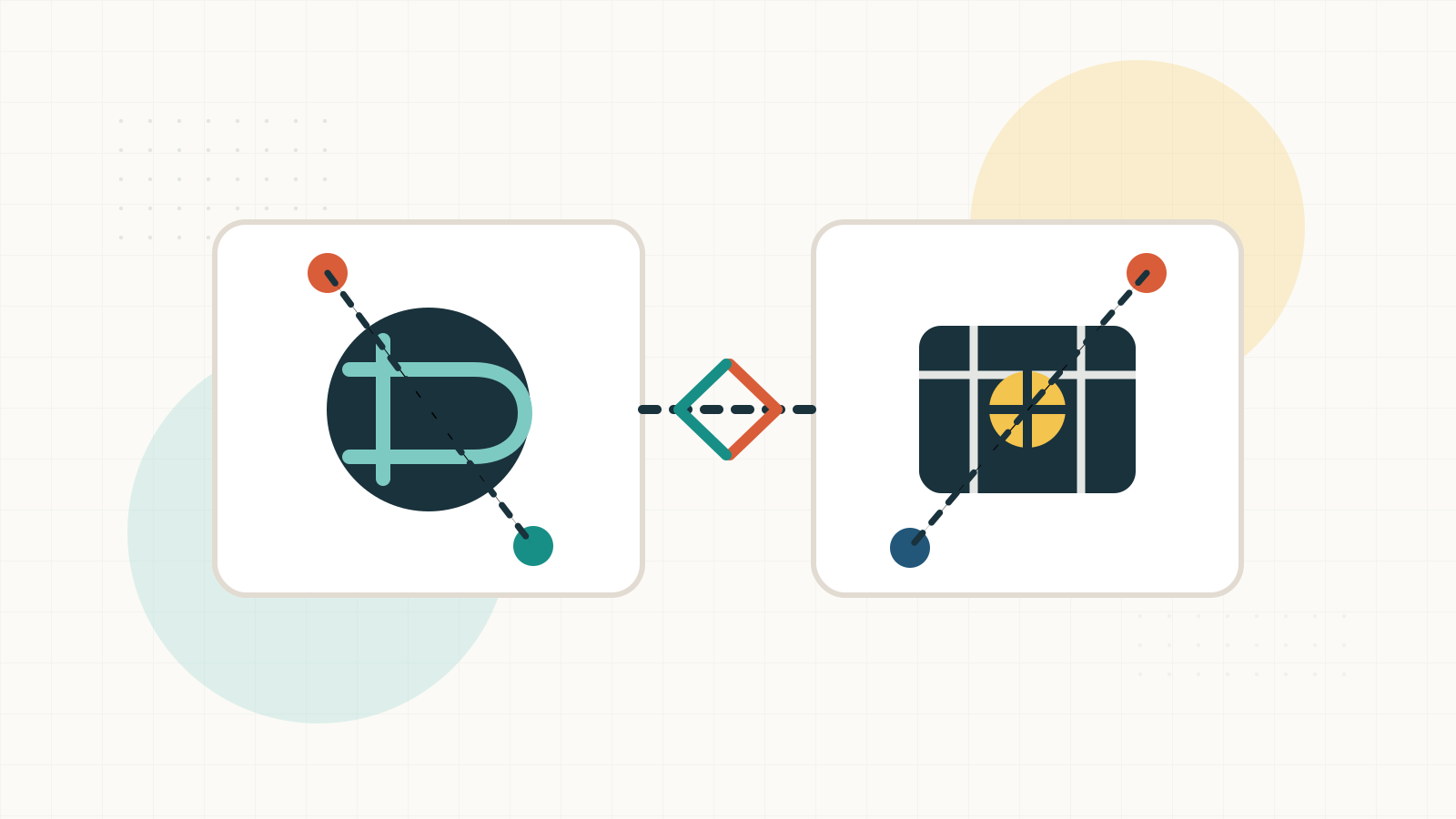
Crypto and CBDCs are often discussed as if they are versions of the same thing. They are better understood as two different answers to one question: who should be trusted to issue and move money?

Why the Difference Matters
Cryptocurrency and central bank digital currency both sound like digital money. That similarity creates confusion.
A cryptocurrency such as bitcoin is usually a privately held digital asset that moves on a public network and is not issued by a central bank. Its value can move sharply because it is not designed to stay equal to a national currency.
A central bank digital currency, or CBDC, is digital public money. It is issued or backed by a central bank and is intended to remain equal to the country’s official currency. A digital euro, for example, would be a euro in digital central-bank form, not a new speculative asset.
The distinction matters because users face different risks. Crypto raises questions about volatility, custody, scams, tax, regulation, and private keys. CBDCs raise questions about privacy, state power, banking-system design, access, and payment resilience.
This article is educational. It is not investment, legal, tax, or financial advice. Digital-asset rules vary by country.
What Cryptocurrency Is Trying to Do
Cryptocurrency grew from the idea that value could move online without relying on a central bank or traditional payment intermediary.
Bitcoin is the best-known example. It uses a public ledger, cryptographic keys, and a network of participants to record transfers. Other crypto networks added programmability, tokens, decentralized finance, NFTs, and applications that run on shared infrastructure.
The strongest crypto argument is openness. A public network can be accessed globally by anyone who can use the software, subject to local law and exchange access. Transfers can happen outside normal banking hours. Users can self-custody assets if they accept the responsibility.
The weakness is that openness does not automatically create consumer protection. Users can lose keys, send funds to the wrong address, encounter fraud, face sharp price moves, or discover that a platform they trusted was not safe. Crypto can also be used for speculation rather than everyday payments.
Stablecoins are a special case. They are crypto tokens designed to track another asset, usually a fiat currency such as the US dollar. They can move on blockchain rails, but their trust depends on the issuer, reserves, redemption rights, regulation, and market liquidity.
What a CBDC Is Trying to Do
A CBDC is an attempt to make central bank money usable in a more digital economy.
Central bank money already exists. Cash is central bank money. Commercial bank deposits are private bank money that people usually treat as money because of regulation, deposit insurance, banking law, and convertibility into cash.
A retail CBDC would give households and businesses a digital form of central bank money. The European Central Bank says the digital euro would complement banknotes and coins. The Bank of England says a digital pound, if introduced, would not replace cash.
CBDCs can also be wholesale. A wholesale CBDC or tokenised central bank reserve system would mainly serve banks and financial institutions. The public may never hold it directly, but it could make cross-border settlement, securities settlement, or bank-to-bank transfers faster and more reliable.
The strongest CBDC argument is trust. A CBDC is meant to be risk-free public money, denominated in the national currency. The weakness is that public money is public infrastructure, so design choices around privacy, access, limits, offline use, and government visibility matter deeply.
The Practical Differences
The first difference is the issuer. Crypto is issued by a protocol, network, foundation, company, or market process. A CBDC is issued by a central bank.
The second difference is value stability. A CBDC should stay one-to-one with the national currency. Many cryptocurrencies are volatile. Stablecoins aim for stability, but that depends on the issuer and reserve structure.
The third difference is legal status. CBDCs are designed inside the legal monetary system. Crypto assets are regulated differently across countries and may be treated as property, commodities, securities, payment tokens, or something else depending on the jurisdiction.
The fourth difference is privacy. Public blockchains can be transparent in ways users do not always understand. CBDCs could be designed with different privacy levels, but they also raise concerns about government or intermediary visibility.
The fifth difference is custody. Crypto users may self-custody assets with private keys or use an exchange or custodian. CBDC users would likely access wallets through banks or approved payment providers, depending on local design.
The sixth difference is purpose. Crypto often serves investment, speculation, decentralized applications, or alternative payment use cases. CBDCs are mainly about payment infrastructure, monetary trust, inclusion, resilience, and public money in digital form.
Where Stablecoins Fit
Stablecoins sit between crypto and CBDCs.
They use crypto-style rails but try to behave like fiat money. A dollar stablecoin, for example, aims to stay close to one US dollar. That can make stablecoins useful for trading, remittances, dollar access, and crypto applications.
The trade-off is trust. A stablecoin user needs confidence that the issuer holds suitable reserves, allows redemption, manages risk, follows law, and can survive stress. The BIS has argued that stablecoins show some promise for faster and programmable payments but also raise concerns around money-like trust, financial integrity, and large-scale adoption.
Stablecoins may influence the future of money even if they do not become the final answer. They have shown demand for faster global digital value transfer. Central banks and banks are now responding with CBDC pilots, tokenised deposits, and shared settlement experiments.
Which One Is Better?
There is no single winner because they serve different needs.
For speculative investors, crypto may offer exposure to open networks and digital assets, with high risk and volatility. For everyday public money, CBDCs are designed to be stable and official. For cross-border digital payments, stablecoins, instant-payment systems, CBDCs, and tokenised bank money may all compete.
The better question is: what problem are you trying to solve?
If the problem is preserving purchasing power in the official currency, a CBDC is closer to ordinary money. If the problem is permissionless access to a decentralized network, crypto is closer to that goal. If the problem is cheap cross-border digital dollars, stablecoins may be relevant, subject to regulation and issuer risk. If the problem is business settlement between banks, wholesale tokenised money may matter more than either retail crypto or retail CBDCs.
Final Takeaway
Cryptocurrency and CBDCs are connected, but they are not the same product in different wrappers.
Crypto asks whether money and financial applications can run on open networks without traditional issuers. CBDCs ask whether central bank money can remain useful in a digital economy. Stablecoins ask whether private issuers can make fiat-like tokens work on crypto rails.
The future of digital money will probably include all three, plus tokenised bank deposits and faster traditional payment systems. The important thing is not the label. It is the trust model: who issues it, what backs it, who can see transactions, what rights users have, and what happens when something goes wrong.
Sources
- ECB digital euro overview
- Bank of England: the digital pound
- IMF digital payments and finance
- BIS Annual Economic Report 2026: innovation beyond stablecoins
- Atlantic Council CBDC Tracker