A Portable Power Station Works From a Runtime Plan
A battery box becomes useful only when it is matched to the appliances that matter during an interruption. The small-business opening lies in a documented critical-load plan, where arithmetic and careful scope can prevent an expensive mismatch.

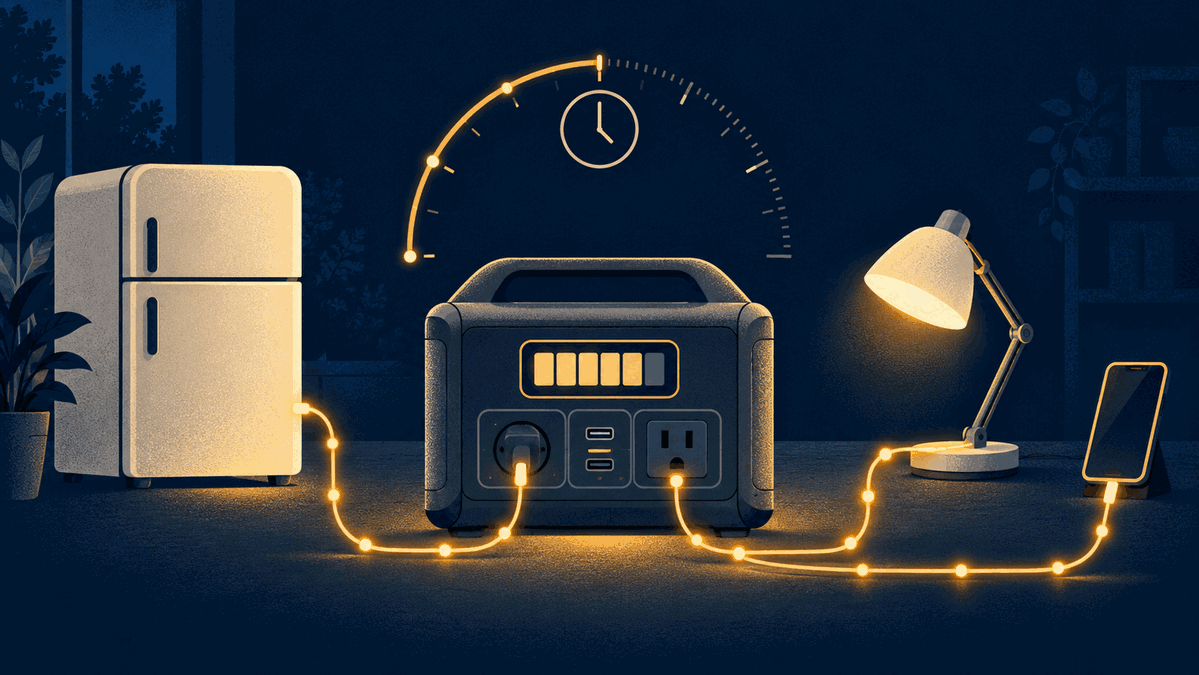
A portable power station looks simple: a large battery, a few outlets and a promise of backup power. The difficult part begins after the purchase. A household may need a refrigerator, a lamp, a router, a phone, a medical device, a pump or a laptop to keep working through an interruption. Each has a different running load, start-up demand, plug type and safety boundary.
That turns the purchase into a planning problem. The useful question is not “Which battery has the largest number on the box?” It is “Which few loads must run, for how long, and under what conditions?” A capacity figure can help answer that question, but only alongside output limits, conversion losses, charging method and a documented list of essential appliances.
This distinction creates a modest opportunity for a careful adviser, facilities helper or publisher. The viable offer is a critical-load and runtime brief for a defined room, small office or household. The customer pays for a decision record: appliance list, measured or manufacturer-stated wattage, estimated runtime range, compatible charging route and questions for a qualified electrician where a building connection is involved. Selling untested battery equipment, modifying packs or promising uninterrupted power belongs outside that offer.
The buying decision starts with watts and watt-hours
Two numbers appear on most power-station listings. Watt-hours measure stored energy. Watts measure the rate at which a station can supply power. They answer different questions.
A 1,000Wh station contains a stated amount of energy. A 1,000W continuous-output rating says it can support loads whose combined running demand stays within that limit. A refrigerator may draw modest power while its compressor runs, yet demand a larger burst when it starts. A kettle, heater, microwave or power tool can exceed a station’s output limit even when the battery has plenty of energy left.
Manufacturers build product ranges around those constraints. Anker’s F3000, for example, is specified at 3,072Wh and 3,600W output, with expansion and other accessories available for larger backup arrangements. Those specifications describe one model. A buyer still needs to match capacity, output and system configuration to their own priority loads. Anker’s product announcement explains the stated limits and options.
The arithmetic is useful if it stays honest. Take a hypothetical 1,000Wh station and a 100W combined load: a router, a few lights and phone charging. The idealised calculation is 1,000Wh divided by 100W, or 10 hours. A planning estimate should be lower because the inverter consumes energy and real loads cycle. Applying an explicit 85% usable-energy assumption gives 850Wh divided by 100W, or about 8.5 hours. The figure illustrates a planning method and does not promise performance. Temperature, battery age, the station’s own standby draw, cable losses and actual appliance behaviour can change the result.
The same method exposes a poor fit. A 1,500W heater could exhaust that illustrative 850Wh usable energy in a little over half an hour if it ran continuously, and it may exceed a smaller station’s output rating. A runtime plan therefore begins by preserving a few critical loads rather than trying to imitate a whole building.
Why the category has a real decision problem
Portable power stations sit between several needs: camping and mobile work, power cuts, home backup and solar charging. People comparing them need help with the difference between an outage kit and a permanent electrical installation. A battery that can keep a router and lights operating may be valuable; it does not automatically make every wall circuit safe or available.
The category also comes with a safety system rather than a single product. The US Consumer Product Safety Commission describes high-energy battery risk as a system issue that includes cells, battery management, thermal protection, the charger and the end product. Its guidance says those components should be evaluated together for the intended use. CPSC’s battery-safety overview is US guidance, yet the basic operational lesson is broadly relevant: use the manufacturer-supplied or approved charging equipment, follow the instructions and do not treat a lithium battery, charger and connected load as interchangeable parts.
This is also why a portable station should not be casually connected to a building’s wiring. A home connection can create backfeed, circuit-loading and local-code issues. The appropriate solution depends on the building and jurisdiction. A small adviser can identify the question and refer the client to a qualified local electrician. They should not design or install a connection without the required competence and permissions.
The durable reader need is clarity. A buyer needs to know whether the station can run the priority loads, whether those loads are safe to connect as intended, how the station will recharge and what happens when the planning assumptions fail. Generic ranking pages often make the first purchase look easier than the first interruption.
Big brands earn from hardware, ecosystems and scale
The established market earns through more than a box of cells. Brands sell stations, expansion batteries, solar panels, charging accessories, service, retail distribution and, in some cases, broader home-energy equipment. The integrated model gives them advantages in procurement, engineering, warranty handling, battery testing, logistics and after-sales support.
Anker Innovations presents its SOLIX business as a home and portable-energy brand alongside its charging, smart-home, audio and creative-tool businesses. Its published sustainability report lists CNY 24.70 billion of prime operating revenue and 112.1 million units of sales for the company in 2024. Those figures cover the broader company rather than portable power stations alone, so they should not be read as category revenue. They do show the scale of the supply, distribution and support base behind a global consumer-hardware brand. Anker’s ESG report provides the broader figures.
That scale is hard to copy and a poor target for a beginner. Holding inventory creates warranty exposure, transport risk, currency risk and a costly obligation when a battery unit fails. Private-labeling a high-energy product adds quality-control and product-liability questions before the first sale. A newcomer has a more realistic place upstream of the transaction, where the customer needs load selection, documentation and a clear escalation path.
The accessible layer is a critical-load brief
A helpful brief has a firm boundary. It does not certify an electrical system or promise emergency resilience. It documents the customer’s stated priority loads and turns them into questions that a buyer can check against official manuals and qualified advice.
- Priority list: name the three to six appliances or functions that matter most, such as communications, lighting, food preservation or work equipment. A device that is merely convenient should be listed separately.
- Load record: capture the appliance label, manual rating or a measured running load where the operator is competent to measure it safely. Record start-up demand as unknown unless reliable evidence is available.
- Runtime range: show the stated station capacity, a clearly labelled usable-energy assumption and a low, middle and high load scenario. Keep the arithmetic visible.
- Charging and placement: record the approved charger, expected charging route, dry and ventilated placement requirements from the manufacturer, and the owner’s plan for keeping cables away from trip or heat hazards.
- Referral questions: flag any request involving building circuits, installed transfer equipment, critical medical equipment, unusual loads or uncertainty about local rules for a qualified professional.
The customer pays for fewer unknowns before spending on equipment. The operator earns a fixed assessment fee or sells a narrowly sourced buyer guide with a clearly disclosed affiliate relationship. The work only has value when it reduces a mistake that would otherwise be expensive or disruptive.
A small calculation tests whether the service has an economic core
Consider a fixed-scope 50-minute runtime brief. Allow 15 minutes for the priority-load interview, 20 minutes to check specifications and calculate two scenarios, and 15 minutes to write the customer-owned record. The calculation is 15 + 20 + 15 = 50 minutes before payment fees, travel, insurance, software or follow-up questions.
That boundary matters. If every client wants site wiring advice, appliance repair or a custom solar design, the offer has discovered a different, more regulated service. If people pay for the same bounded record and use it to choose a station or avoid an unsuitable one, the work may support repeatable checklists, content or a referral partnership.
The calculation also gives the operator a stop rule. If the time needed to understand an appliance or a building connection exceeds the appointment, pause the work and refer it. A transparent handoff protects both the customer and the margin. Pricing, insurance, consumer protection and tax treatment vary by country, so a paid operator should check local requirements before offering the service.
Start with a no-inventory pilot
The smallest sensible test is a documented, manual service rather than a stock purchase. Choose one audience with a recurring need, such as remote workers who rely on connectivity, small studios with a defined essential-load list or caravan owners who already understand their own equipment. Create a one-page offer for a “critical-load and runtime brief.” State the inputs, deliverable, time limit, exclusions and referral boundary.
Speak with five prospective users or relevant local operators. Ask what failed during their last interruption, which appliance they were trying to keep running, whether they knew its wattage, and what they bought or borrowed. Then offer three paid pilot briefs using only manufacturer documentation, customer-supplied information and visible calculations. Do not sell a station, open a battery case, alter a charger, connect to building wiring or advise on medical continuity.
The strongest signal is repeated payment for the same narrow outcome, followed by the same two or three questions in each brief. That pattern supports a checklist or a carefully maintained comparison guide. Interest in a free product recommendation does not establish that people will pay for planning.
Who this suits, and where the boundary belongs
This can suit an established local technology-support provider, an energy-education publisher, a facilities helper with clear referral relationships, or a creator who already makes careful equipment comparisons. The defensible asset is trust in the method: accurate load records, transparent assumptions, manufacturer-linked sources and a willingness to say when the answer needs an electrician or other qualified professional.
It does not suit a beginner looking for quick retail margins, a general handyman without the required electrical competence, or anyone planning to repair, rebuild or mix lithium battery components. CPSC materials emphasise that high-energy battery products require safety systems and components that work together. That makes improvised repairs and “universal” charging claims a serious risk rather than a clever shortcut.
Portable power stations can solve a real and practical problem. The sound small-business angle is a planning layer that helps a customer identify critical loads, compare stated capability and preserve safety boundaries. Prove that people will pay for that record before buying inventory or expanding into electrical work.
Sources
- Anker SOLIX F3000 product announcement
- Anker Innovations ESG report
- Anker Innovations brand information
- US CPSC battery safety overview
- US CPSC high-energy battery standards information